
There is a growth hack making the rounds again: post a job you have no intention of filling, watch applicants and lurkers follow your company page, screenshot the follower chart, sell a course about it. It works. It just works on the wrong number.
This guide breaks down the exact mechanic that makes hiring posts spread, then gives you four honest ways to grow a LinkedIn company page with buyers instead of applicants, plus the conversion layer almost nobody builds behind the follow.
Key takeaways
- The follower count on a company page is the least useful number you own. A page with 2,000 right-fit followers outperforms one with 50,000 job seekers.
- Hiring posts spread because of three mechanics: a distribution surface built for jobs, the lowest-friction call to action on the platform, and curiosity beating value claims.
- You can copy all three mechanics honestly. The pilot-recruitment post is the single most underused company page format right now.
- LinkedIn's Jobs Policies prohibit postings without a legitimate intent to hire. Enforcement runs from job removal to suspended posting ability to account restriction.
- Followers only matter if something happens after the follow. Build the pinned post, the featured section, and the follow-up loop before you chase reach.
- Your founder account will always outreach the page. Stop treating them as separate entities and start using one to feed the other.
The follower number is the least useful metric on your page
Start here, because everything else follows from it. A company page follower is not a subscriber. They will not reliably see your next post. LinkedIn distributes company page content far more conservatively than personal content, which is why a 40,000-follower page routinely posts to 12 likes and a founder with 4,000 connections gets 80.
Employee advocacy research keeps landing on the same finding: the identical post shared by a person beats the same post from the brand page, usually by several times the engagement. The exact multiple moves around between studies. The direction never does. That gap is not a formatting problem, it is structural. The platform is built around people, and pages are treated as advertisers who happen to post.
So when someone shows you a follower chart going up and to the right, the only honest questions are:
- What percentage of those followers are in your ideal customer profile?
- How many of them saw your last three posts?
- How many conversations started because of the page?
Fake job posts score terribly on all three. The people who follow a hiring post are, almost by definition, job seekers. A real audience with real needs, just not yours. If you sell to heads of RevOps, a page full of graduates does not move a single deal, and it poisons your analytics so badly you stop being able to read them.
Why fake job posts work: the three mechanics underneath
Most people stop at "fake jobs grow followers" and never ask why. The why is the useful part, because the mechanics are transferable and the deception is not.
Jobs have their own distribution surface. A hiring post is not just a text post. LinkedIn's "Share that you're hiring" flow adds the #Hiring frame to your profile photo, features your profile in the job's Meet the team section, and notifies your network so they can reshare it. That is three extra distribution surfaces a normal post never touches.
Follow is the cheapest action on LinkedIn. Liking is a public endorsement. Commenting is a public performance. Booking a demo is a commitment. Following a page costs nothing socially and takes one tap.
Curiosity beats value claims. "We're hiring a Senior Engineer" gets read. "5 tips to improve your LinkedIn strategy" gets scrolled. Not because the first is more useful, but because it implies something specific, personal, and time-bound. An open role is news. A tips list is content.
Extra distribution, a one-tap CTA, and news framing. Nothing in that list requires lying.
The part the growth-hack posts leave out
LinkedIn explicitly prohibits it. LinkedIn's Jobs Policies require that a job post be created for a bona fide opportunity with a reasonable and legitimate intent to hire for the specific position listed. Posts created primarily for user acquisition, self-promotion, or any purpose other than genuine hiring are not permitted. LinkedIn's job violations and enforcement policy describes the ladder: the job is removed, you get an email notice, repeated violations temporarily suspend your ability to post jobs, and in some cases the account is restricted.
The free tier does not support the volume the hack needs. You can keep one free job post active at a time, it runs up to 14 days before it pauses, and reposting a job with the same title and company inside 7 days requires you to promote it. The "post fake jobs every week" version of this hack quietly becomes a paid ad campaign.
The reputational math is getting worse. Ghost jobs are now a mainstream story, not an insider secret. Greenhouse's 2025 research estimated that somewhere between 18% and 22% of online job postings are ghost jobs, the US Congressional Research Service has published on the phenomenon, and lawmakers in several states have moved to restrict it. Your buyers read the same feed your applicants do.
The fake job post is not a growth hack. It is a loan against your reputation, taken out at a rate you do not get to see until it comes due.
Do the page basics once, then stop touching them
Every generic guide on this topic is a list of these. They are table stakes, not strategy, so spend an hour and never think about them again.
| Element | What to do | Why it matters |
|---|---|---|
| Banner and logo | A 1128 by 191 banner stating what you do for whom, not a slogan | It is the only thing a visitor reads before deciding to follow |
| About section | Put your category keywords in the first 150 characters | LinkedIn and Google both index it, and it is the searchable part |
| Custom button | Set it to the same offer as your pinned post | The default is a dead end |
| Employee association | Make sure every teammate lists the page as their employer | This is what drives the reshare multiplier |
| Invitations | Invite your first-degree connections in batches | Free, and the only lever that works before you have content |
| Video | Post native video regularly | LinkedIn's own page guidance leads with it, and it holds attention longer than text |
That last row is the exception. When LinkedIn publishes advice about its own pages, video is item one, and it holds attention longer than a text post of the same quality. It is the one basic that is also a real lever.
Four honest formats that hit the same mechanics
Each of these copies at least two of the three mechanics with an audience that can actually buy from you.
1. The pilot-recruitment post
The direct analogue of the hiring post, and almost nobody runs it. You are not recruiting an employee, you are recruiting a small cohort of your exact buyer to test something. It is news, it names a specific person, and the CTA is one low-friction action.
We're looking for 7 agency owners running 10 to 30 client LinkedIn accounts
to test something with us for 3 weeks.

Here's the problem we keep hearing: you can write good posts for a client,
but you cannot remember what each of them believes. So every handover
sounds like a different person wrote it.

We built something for that. We want 7 people to break it.

What you get: the full build, direct access to us, and the teardown
document either way.
What we get: your honest reaction, on a call, twice.

Comment "pilot" or follow the page and we'll send the brief.
An agency owner reading that self-identifies in the comments, which hands you a qualified list you can work through one by one. The follow is incidental, which is exactly why people do it.
To run it as a sequence rather than a one-off, that is what LiGo's Post Lab agents are built for. Funnel Architect takes an offer you want to test and designs a 5 to 7 post campaign over roughly two weeks, each post with a defined job in the arc: build the problem, name the cohort, open the door, close it. Every post runs through LiGo Brain, so it sounds like the person who normally writes for you.
2. The real hiring post, framed around the customer's problem
If you are genuinely hiring, hire loudly. You have earned the distribution. Just do not write the job description version.
We're hiring a support engineer, and the reason is the interesting part.

Three of our last five churn calls said the same thing: "we got it working,
then the person who set it up left."

So we're not hiring someone to answer tickets. We're hiring someone to make
the setup survive turnover. Documentation, handover packs, a 30-day check-in
that is not a QBR.

If you have felt that problem from the customer side, I'd genuinely like to
hear how you solved it. Comments are open.

Role and details in the first comment.
You keep the hiring distribution, and buyers self-identify in the comments because you asked a question they have opinions about. It is a positioning post disguised as a job post, and it is entirely true.
3. The customer as protagonist
Post the case study from the page, but make the customer the hero and tag them. The point is not your page's audience. The point is theirs.
Their network is full of people with their job title, which is your ideal customer profile by definition. When they comment on their own story, the post enters their network's feed with a warm endorsement attached. It is the single most reliable way a company page reaches people who do not already follow it. Our guide to turning company page comments into leads covers how to work the thread afterwards.
Three rules: name a number, name the person, and let them approve the draft before it goes out.
4. The founder POV, reshared by the page within the hour
Stop pretending the page is a separate entity. Founder accounts get reach that pages structurally cannot, so the page's job is to borrow it.
Write the contrarian take from your personal profile. Have the page reshare it with one line of commentary inside the first hour, while the post is still in its distribution window. The page gets associated with a real opinion, and the followers who arrive came for a point of view rather than a job.
If you never know what to be contrarian about, that is a memory problem, not a creativity problem. LiGo's Opinion Miner agent reads the stances already stored in LiGo Brain and surfaces the ones with edge. Trending Topic Scout does the same from the outside, watching Reddit, Hacker News, X, and industry news for the debates running in your niche this week. More on why the personal profile outperforms the company page.
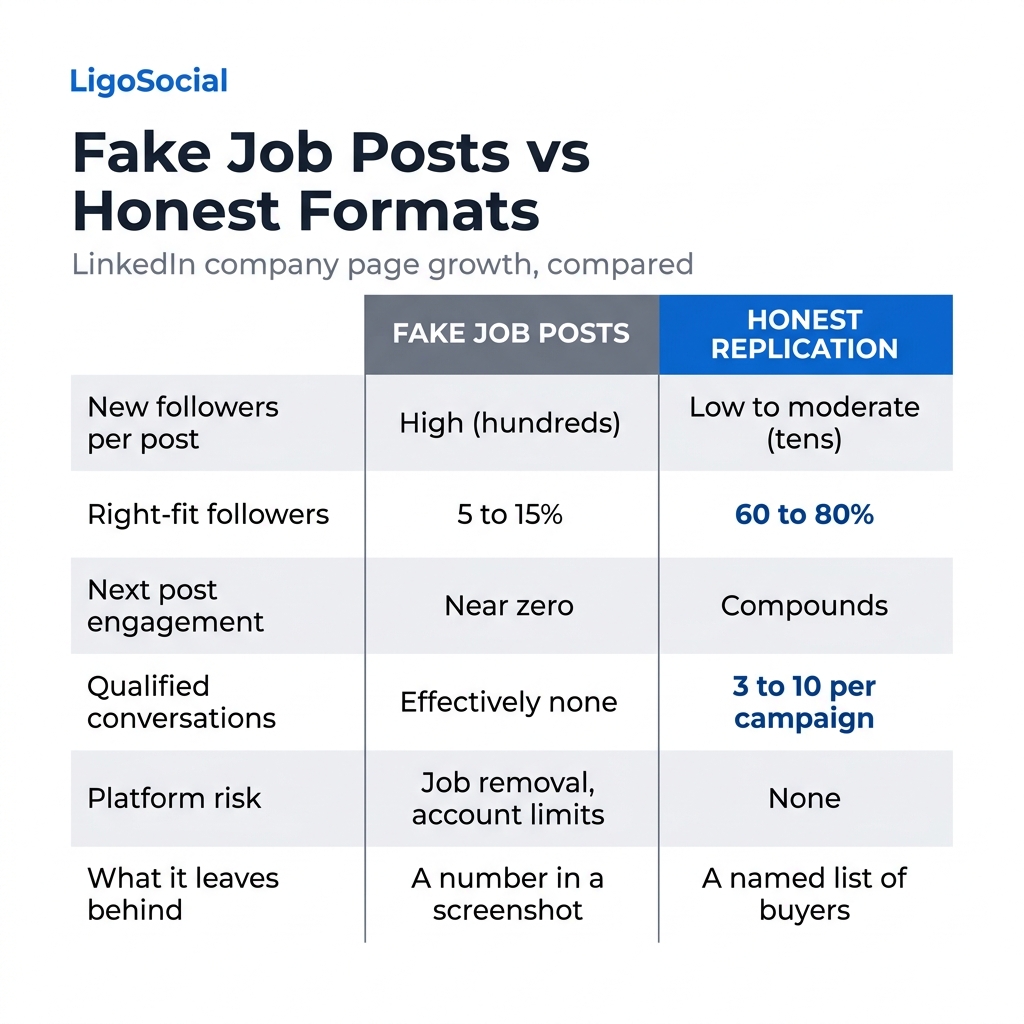
Fake jobs vs the honest replication, side by side
Directional numbers from running both patterns. The point is the shape, not the decimal.
| Metric | Fake job posts | Honest replication |
|---|---|---|
| New followers per post | High (hundreds) | Low to moderate (tens) |
| Right-fit followers | Roughly 5 to 15% | Roughly 60 to 80% |
| Engagement on your next non-hiring post | Near zero, the audience is gone | Compounds, the audience stayed for the topic |
| Qualified conversations started | Effectively none | 3 to 10 per campaign |
| Platform risk | Job removal, suspended posting, possible account restriction | None |
| What it leaves behind | A number in a screenshot | A named list of buyers who raised a hand |
The conversion layer nobody builds
This is the part the growth-hack crowd skips entirely, because their followers cannot convert, so there is nothing to build. A follow is a permission, not a result.
A pinned post that is an offer, not an announcement. Give a new follower one specific next step. Not "welcome to our page." A teardown, a template, a 15-minute audit.
A featured link that matches the pinned post. If the pinned post promises a brief, the featured link delivers the brief. The number of pages where those two point at different places is remarkable.
A cadence that assumes the follower is a buyer. Write to the person who has the problem, not the person who admires your culture. Product updates and office photos are for people who already bought.
A follow-up loop. Everyone who commented "pilot" is a warm lead with a name attached. The failure mode is not lack of intent, it is lack of memory: three weeks later nobody remembers who raised a hand.
That is the job LiGo's Engagement Lists do. Save any LinkedIn search as a one-click curated feed, so instead of scrolling the main feed hoping to bump into the right people, you open the list of 30 people who engaged with your pilot post and work through it deliberately. The comment co-pilot in the Chrome extension drafts your reply in your own voice, and you post it after reviewing it. Our own working split is that growth is roughly 80% strategic commenting and 20% original posting, which is why the system is built around the comment rather than the post.
Here is the feature in action:
How to grow a LinkedIn company page in 30 days
Two posts a week from the page, three from the founder, one campaign. That is the whole thing.
| Week | Page posts | Founder posts | The one thing that matters |
|---|---|---|---|
| 1 | Pilot-recruitment post, then a reshare of the founder POV | 3 posts on the problem the pilot solves | Reply to every pilot comment within 4 hours |
| 2 | Customer-as-protagonist case study, tagged | 2 posts, 1 reshare of the case study | Save every commenter into an engagement list |
| 3 | Behind-the-build post on what the pilot found | 3 posts, one of them contrarian | Comment on 10 pilot-commenter posts, not about you |
| 4 | Results post naming what changed, plus the next door | 2 posts, 1 reshare | Move 3 named conversations to a call |
Notice what is missing: there is no "post daily to feed the algorithm." Two good page posts beat ten filler ones, because filler trains your followers to scroll past you. For the fuller planning version, see the complete guide to LinkedIn company pages and our walkthrough of getting your first 1,000 company page followers without ads.
Frequently asked questions
What is the 4-1-1 rule on LinkedIn?
For every six posts, four should educate or entertain, one should be a soft mention of your work, and one can be a direct pitch. It is a useful guardrail against turning a page into a product feed. The ratio matters more for company pages than for personal profiles, because followers are quicker to mute a brand that only sells.
What is the 95-5 rule on LinkedIn?
It comes from LinkedIn's B2B Institute and says that at any moment roughly 95% of your potential buyers are not ready to buy, while only 5% are in market. The implication for a company page is direct: most of your posts should build memory with the 95%, not chase conversion from the 5%. It is also a strong argument against fake job posts, because filling your audience with job seekers means the 95% you are supposed to be reaching is not there at all.
How do you get 1,000 followers on a LinkedIn company page?
Slowly and on purpose. Invite your existing network and your team's networks, add the page to every employee profile, publish two substantive posts a week, and reshare founder content within the hour. The biggest accelerator is employee resharing, because employee networks are collectively far larger than any page's follower list. Buying followers or farming them from fake job posts gets you there faster and leaves you with an audience that never engages.
Can ChatGPT optimize my LinkedIn company page?
It can draft an About section and give you post ideas, which is genuinely useful for the one-hour basics pass. What it cannot do is sound like your company, because it has no memory of how you actually write, and no view of who engaged with you last week. That is the gap LiGo Brain fills: it trains on your existing posts, per profile, so drafts come back in your voice rather than in the default register every AI tool shares.
Are ghost jobs illegal?
In most places, not currently, though several US states have moved to restrict them and the Congressional Research Service has published on the issue. Legality is the wrong bar, though. LinkedIn's own Jobs Policies already prohibit posting without a legitimate intent to hire, and LinkedIn enforces that with job removal, suspended posting ability, and in some cases account restriction. You do not need a law to lose the surface you were trying to exploit.
Does buying LinkedIn followers work?
It inflates the number and damages everything the number was supposed to represent. Purchased followers do not engage, which lowers the engagement rate LinkedIn uses to decide how widely to distribute your next post. You end up with a bigger audience and less reach, and your analytics stop telling you anything true about your real buyers.
The uncomfortable version
Fake job posts are cheap because they externalize the cost. Job seekers pay it in wasted applications, the platform pays it in trust, and your brand pays it when someone screenshots your page. They are also a tell: a founder posting fake roles has not yet worked out how to make their real business interesting in public, so they borrow the one format that reliably gets attention.
The honest version is slower, and it is the only version that compounds, because every post leaves behind a named person instead of a number.
If you know what to write but never when, or you have the opinions but not the time to shape them into posts, that is the gap LiGo closes. LiGo Brain learns your voice from your existing writing, Post Lab's agents handle the campaign structure, and the Chrome extension turns comments into a system instead of a scroll. It publishes through LinkedIn's official OAuth API, so it is a co-pilot rather than an automation bot that puts your account at risk. Try it at ligosocial.com.
LiGo is built by Ertiqah, and it started as an internal tool: the team was losing more than ten hours a week to LinkedIn and wanted that time back. The pattern that showed up once it was in use is the same one this article is about. The accounts that grew were never the ones chasing followers. They were the ones that remembered who they had already talked to.