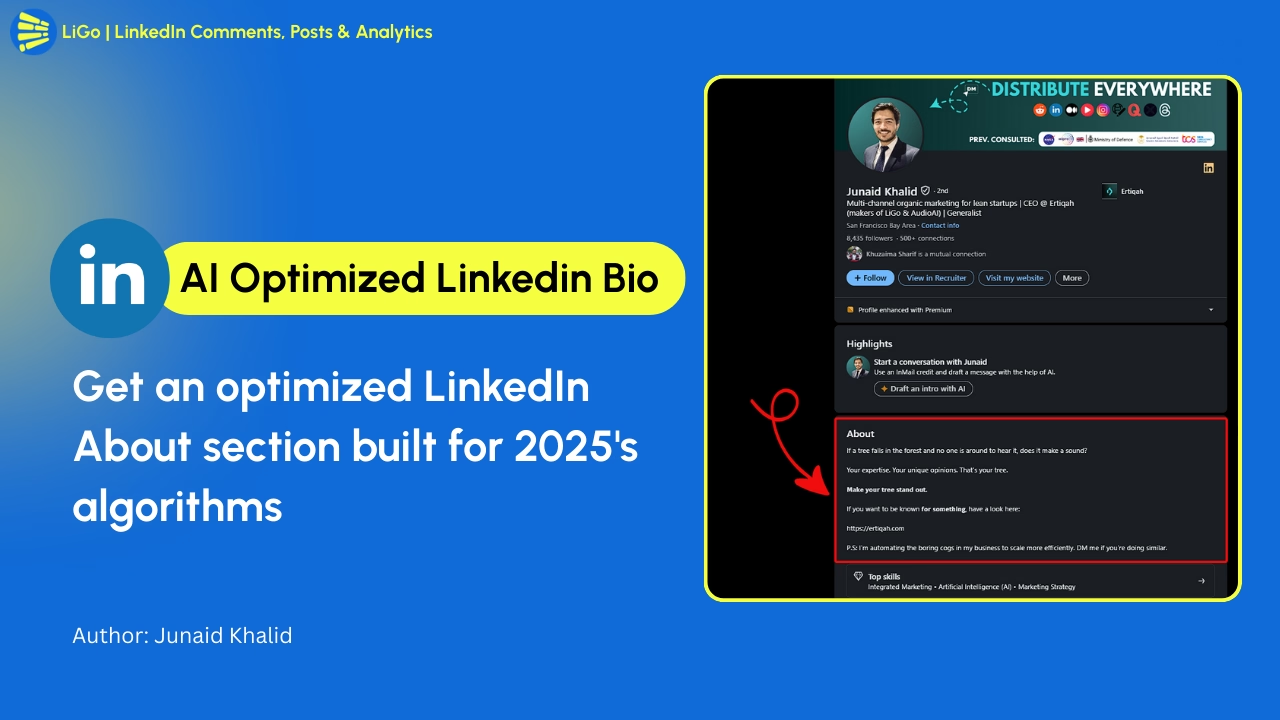

Your About section is not a biography. It is the answer to the one question every visitor is silently asking: "Why should I care about you?"
Whether the visitor is a prospect deciding whether to message you, a recruiter deciding whether to reach out, a hiring manager reading before an interview, or a peer deciding whether to follow, the About section is where they decide. Most people waste it on a job title and a mission statement, which is a big part of why 95% of LinkedIn summaries fail to do any work at all. Good news for you: you do not have to do much to stand out. You just have to be specific, and lead with them.
This guide gives you five full, copy-ready examples (agency owner, freelancer, job seeker, corporate professional, and salesperson), one real annotated profile, a fill-in template you can paste and edit, and the exact structure underneath all of them. Steal what fits and go.
Key takeaways
- Your About section holds up to 2,600 characters, but only about the first three lines show before "see more," so the first line has to earn the click.
- Write in first person. "I" and "my" read like a real person; third person reads like a press release.
- Lead with who you help and the outcome you create, not your job title or a mission statement.
- End with one clear next step: a low-friction "message me here with [detail]," never "feel free to connect."
- Work in the words your ideal reader would actually search, because LinkedIn indexes your About text in people-search.
- Steal one of the five examples below, swap the brackets for your specifics, and treat every number as a placeholder for your real one.
The one rule: win the first two or three lines
LinkedIn truncates the About section. Only about the first three lines show before the "see more" link, and the exact cutoff shifts by device and by how long your lines are. Most visitors never expand it. So the opening is not a warm-up. It is the whole pitch for the people who never click further.
That single constraint drives everything below. Do not open with your title. Do not open with "I am a results-driven professional." Open with a sentence that names your reader's problem or their identity, sharp enough that the right person feels seen and clicks "see more." Think of it as the partner to your headline: strong LinkedIn headline examples stop the scroll, and the first line of your About decides whether the right person keeps reading.
We learned this the hard way with LigoSocial. Early profiles we tested opened with a role and a tidy mission line, and almost nobody expanded them. The versions that opened with a blunt problem, in the reader's own words, got read. Same person, same career, very different result, decided entirely in the first two lines.
One number worth knowing: the About section holds up to 2,600 characters. That is plenty. The goal is not to fill it. It is to earn attention line by line, because LinkedIn also indexes this text in search, so the words you choose decide whether the right people find you at all.
The template underneath every good About section
Think of the About section the way a good LinkedIn post is built: a Trailer that earns the next scroll, the Meat that proves you can help, and a close that starts a conversation instead of begging for a click. Adapted to a profile, that is five parts.
Part 1: The hook (your first two or three lines). Name the reader or their problem. No title, no mission statement. This is the only part you can count on people reading.
Part 2: What you do, and who for. One clear sentence on the outcome you create and exactly who you create it for. Specific beats broad every time.
Part 3: The proof. A short, scannable stack of evidence: results, a client line, a shipped project, numbers where you have them. One item per line so it survives a scan.
Part 4: How you are different. Two or three lines on your approach, so you do not read as interchangeable with everyone else in your field.
Part 5: The call to conversation. Tell the reader the single next step and make it easy. Invite a message with a low-friction prompt. Optionally, one human line at the end so you read like a person, not a pitch deck.
Here is the same skeleton as a quick reference, with a rough length guide:
| Section | What it does | Length guide |
|---|---|---|
| Hook line | Names the reader or their problem so the right person clicks "see more" | 1 to 2 lines |
| What you do + for whom | States the outcome you create and exactly who you create it for | 1 to 2 lines |
| Proof / results | Stacks scannable evidence: results, clients, shipped work, numbers | 3 to 5 lines |
| How you work / what makes you different | Shows your approach so you do not read as interchangeable | 2 to 4 lines |
| Call to action / how to reach you | Names the single next step and makes it low-friction | 1 to 2 lines |
Here it is as a fill-in template you can paste and edit:
[One sharp line that names your reader or their problem. No job title.]

[One line that raises the stakes or the curiosity, so they click "see more."]

I help [specific audience] [specific outcome] by [your approach].

What makes my work different:
- [Point one, concrete, not a buzzword]
- [Point two]
- [Point three]

Proof:
- [Result, project, or number one]
- [Result, project, or number two]
- "[One short line a client or colleague said about working with you.]"

[What you are focused on or open to right now.]

[The single next step: "Message me here with [one detail]" or a link.]

[Optional: one human line, a hobby or a value, so you sound like a person.]
Staring at those brackets and still stuck? The free LinkedIn Summary Generator fills them in with a first draft in your own voice that you can edit, no signup required.
Now the examples. In each one, swap the bracketed details for your own, and treat any numbers as illustrative placeholders to replace with your real ones.
Example 1: Agency owner or consultant
Goal: turn profile visits into client inquiries. Leads with the prospect's frustration, proves outcomes, invites a low-friction message.
Most agencies will tell you they do "full-service digital marketing." Then they hand you the same playbook they gave the last ten clients.

I built [Agency] to do the opposite.

I help B2B software companies between $2M and $10M in revenue grow through one thing done well: customer acquisition that ties every dollar to pipeline, not vanity metrics.

How that works in practice:
- We start with customer research, not ad spend.
- We build systems across channels, not one-off campaigns.
- We report on revenue influenced, not impressions.

A few results from the last year (yours will differ, these are mine):
- Cut a client's cost per qualified lead by about a third in a single quarter.
- Rebuilt a demo funnel that had stalled and doubled booked calls.
- Took over a content program that now brings in inbound every week.
- "[One line a client said about the outcome and what it was like to work with you.]"

I take on a small number of new partners each quarter. If your growth has plateaued and you want a team that treats your numbers like its own, message me here with two lines about where you are stuck.

Off the clock: long-distance runner and a terrible-but-improving home barista.
Why it works: the first two lines name a frustration the ideal client already feels, the "who for" is specific enough to repel the wrong leads, and the close asks for a message, not a "let's connect." If turning profile visits into pipeline is the whole point, pair this with a profile built for it: how to optimize your LinkedIn profile for lead generation.
Example 2: Freelancer or independent professional
Goal: book project work. Opens on the client's exact words, shows process and proof, ends with a clear next step.
"We need copy that actually converts, not just fills the page."

That sentence is how most of my projects start. If you just nodded, we should talk.

I am a freelance conversion copywriter for B2B tech teams. I turn website and email copy that sounds like everyone else into words your best customers recognize as their own.

My process is simple:
- I interview your customers and pull the exact language they use.
- I structure each page around the one action you want a reader to take.
- I work in the search terms that matter without making the copy sound robotic.

Before going independent I ran marketing in-house, so I write with both the strategist's and the operator's hat on.

Recent projects (illustrative, replace with your own):
- A rewritten pricing page that noticeably lifted trial signups.
- A launch email sequence that paid for the whole project in its first week.

I am booking new copy projects for [month]. If your site gets visitors but not enough of them act, message me here or email [address] with a link and one sentence on the goal.

When I am not writing: documentary photography and an ongoing, humbling attempt at sourdough.
Why it works: the opening quote is voice-of-customer, so the right buyer feels understood before you have said a word about yourself. The proof is small and believable, not a wall of inflated metrics.
Example 3: Job seeker or career changer
Goal: get found by recruiters and get replies from hiring managers. No client inbound needed. Leads with the value you bring and makes the target role obvious.
I am a data analyst who moved from finance into tech, and I care about one thing above all: turning messy data into decisions a team can actually act on.

Two years ago I was a financial analyst buried in spreadsheets. I taught myself SQL and Python on nights and weekends, rebuilt my team's reporting from scratch, and cut a monthly report that used to take days down to a couple of hours. That is when I knew where I wanted to work.

What I bring to a team:
- SQL and Python, plus dashboards in Looker and Tableau.
- The habit of turning a fuzzy business question into the right query.
- Plain-language explanations, so non-analysts can actually use the findings.

What I am looking for: an analyst role on a team that ships decisions, not just charts, ideally in fintech or SaaS.

If you are hiring for something like that, or you just want to compare notes on breaking into analytics, message me. I answer every one.

Outside work: volunteer math tutor and weekend hiker.
Why it works: recruiters skim the About for fit and for keywords, so the skills are named plainly (which also helps you surface in search), the career-change story is framed as an asset, and the target role is stated outright so no one has to guess.
Example 4: Corporate professional or individual contributor
Goal: build authority in your field and stay visible to recruiters while employed. Leads with the thread through your work, not your title.
I lead product marketing at [Company], where I spend my days making a complex product feel simple to the people who buy it.

The thread through my career: I am happiest at the seam between the technical team and the customer. I translate what engineering builds into a story sales can sell and buyers actually understand.

A few things I have shipped:
- Led the launch of [product or feature] to [audience], from positioning through sales enablement.
- Rebuilt how we onboard new customers, which cut early churn.
- Grew a small internal community into a room where teams share what is actually working.

I write here most weeks about positioning and go-to-market, usually the unglamorous parts that decide whether a launch lands.

Always up for comparing notes with other product marketers, and open to conversations about interesting roles down the line. The best way to reach me is a message here.

Away from the desk: amateur potter, dad, and an occasional slow 10K.
Why it works: it reads as a person with a point of view, not a resume. It signals both "I know my craft" (for peers and internal visibility) and "I am reachable" (for recruiters), without shouting "open to work."
Example 5: Sales professional
Goal: earn a buyer's trust before the first call and pull in inbound from your network. Leads with the reader's guard against salespeople, then sells honesty as the difference.
Nobody wakes up wanting to "hop on a call with a sales rep." I get it. So I try to be the exception.

I sell [category] software to [buyer role] at [company type], and my job is simple: help you decide whether we are a fit, fast, without the runaround.

How I work:
- I send you the pricing and the honest trade-offs before you have to ask.
- If we are not the right fit, I will say so and point you somewhere better.
- I stay useful after the deal closes, not just until it does.

What that has looked like:
- Helped [number] teams roll out [product] without the six-month implementation horror story.
- Consistently one of the top reps on my team, but the number I care about is renewals.
- "[One line a customer said about what it was like to buy from you.]"

If you are evaluating [category] and want a straight answer instead of a pitch, message me here with the one thing you are trying to fix.

Off the clock: youth soccer coach and maker of reliably average homemade pizza.
Why it works: the first line disarms the reader's built-in guard against salespeople, honesty becomes the differentiator instead of a discount, and the close invites a low-pressure message rather than a booked demo.
A real, annotated example
Here is my own About section, lightly trimmed, with the parts labeled so you can see the structure at work in a live profile rather than a template.
You're not a content creator. You're a business owner.          <- Hook

You run an agency, a consultancy, or a professional services firm. You've been at it for years. You have real clients, real revenue, and a real reputation.

But marketing has changed faster than your business has adapted to it.

New platforms. Algorithm shifts. AI tools everywhere. The "content strategy" from three years ago doesn't work anymore. You need to modernize, but you don't have 40 hours a week to figure out which tools and channels actually matter.          <- What I do, who for

That's what I write about here. And that's what I build at Ertiqah.

8,700+ followers, and $0 spent on paid ads. Ever. (self-reported)          <- Proof

If you run an agency, consultancy, or professional services firm and want marketing that works without becoming your second full-time job:

ertiqah.com          <- Call to conversation
The first two lines do the entire job for anyone who never clicks "see more." They reframe the reader's identity ("you are a business owner, not a content creator") before saying a single thing about me. The proof is one scannable, honest line, not a paragraph. The close points to exactly one next step. The numbers there are self-reported from my own profile, which is the honest way to use proof: show your real numbers, and do not borrow anyone else's.
If you want the whole skeleton in one view, here is how the five parts stack inside the 2,600-character box, with the "see more" fold marked where most readers stop.

The five-part anatomy of a LinkedIn About section that converts: hook line, what you do for whom, proof, how you are different, and a clear call to action, with the "see more" fold after about the first three lines.
Draft your first version in minutes (then edit hard)
A blank box is the hardest part. So do not start from blank.
The free LinkedIn Summary Generator gives you a structured first draft to edit. You paste in your role and a few facts, and it returns a full About section you can rework into the template above. It is free and needs no signup, so it costs you nothing to get past the empty page.
If you want that draft to already sound like you rather than like generic AI, that is the job of LigoSocial Brain, the voice layer behind LigoSocial. It learns how you write from the posts you connect or upload and a short set of questions it asks about your tone, your opinions, and your stories, then drafts a first-person About in your voice. The point is never "AI wrote my profile." The point is you get your own voice on the page faster, then you edit it until it is exactly right. A generator gets you 70 percent there in a minute; the last 30 percent, the specific proof and the human line, is yours.
Best practices that actually move the needle
These habits separate an About section that gets read from one that gets skipped. They are also the backbone of personal branding on LinkedIn more broadly, and they scale down to your shorter LinkedIn bio too.
Write to one person, not everyone. "I help businesses improve their marketing" says nothing. "I help B2B SaaS teams with 10 to 50 people fix funnels that book demos but stall before the sale" makes the right reader feel called out. Specificity is the whole game.
Put your keywords in real sentences. LinkedIn search reads your About text, so the terms a client or recruiter would type should appear naturally in how you describe your work, not stuffed as a comma-separated list.
Build visual structure. LinkedIn does not support bold or italics inside the About section, so use short lines, white space, and simple symbols (arrows, dashes) to make the block scannable. Nobody reads a paragraph block of 2,000 characters.
Keep first person. "I" and "my" read as a real person talking. Third person ("Jane is a dedicated professional...") reads as a press release and adds distance.
End the last few lines on a human note. One line about what you do off the clock gives people a reason to remember you and something easy to open a conversation with.
Revisit it quarterly. Update your current focus, your availability, your newest proof, and your call to action whenever your goals shift.
Common About section mistakes to avoid
The biography. A chronological life story ("I started my career in 2011 as a junior associate...") is never for the reader's benefit. That belongs in your Experience section. The About section is for what you do for them now.
The buzzword pile. "Passionate, innovative, strategic, results-driven professional" is invisible. Every one of those words could describe anyone, so they describe no one. Replace adjectives with specifics and outcomes.
Third person. It feels formal and dated, and it puts a wall between you and the reader. Write as yourself.
The credential stack. Opening with degrees, certifications, and awards before you have shown any relevance prioritizes validation over connection. Lead with the reader's problem; the credentials can come later, or live in the bio and Experience sections.
The limp closing. "Feel free to reach out if you'd like to connect" wastes your last line. Name the exact next step and make it easy to take.
FAQ
What should I write in my LinkedIn About section?
Write it in five moves: a hook line that names your reader or their problem, one clear line on the outcome you create and who you create it for, a short stack of proof (results, clients, shipped work), a line or two on how you work differently, and one specific next step. Skip the chronological life story and the buzzword pile. The whole section answers a single question for the visitor: "why should I care about you?"
How long should a LinkedIn About section be?
LinkedIn allows up to 2,600 characters. You do not need all of them. Aim for enough to move through the five parts (hook, what you do, proof, how you are different, call to action), usually somewhere around 1,500 to 2,000 characters. Substance matters more than length, and the first few lines matter more than the rest combined.
Should the About section be first person or third person?
First person. "I" and "my" create a direct, human connection. Third person ("Jane is a dedicated professional...") reads like a corporate bio and puts a wall between you and the reader.
How many lines of the About section show before "see more"?
About the first three lines on desktop, and the exact cutoff shifts by device and by how long your lines run. Most visitors never expand it, so treat that opening as the entire pitch and lead with your sharpest line.
What is a good LinkedIn About example for a job seeker?
Lead with the value you bring and the role you want, not your last title. Name the field you are moving toward, show proof of motion (a project you built, a course you finished, a result you drove), and state the target role outright so recruiters do not have to guess. Example 3 above is written exactly for this case, and it doubles as a career-changer template.
Do keywords in the About section really matter?
Yes. LinkedIn indexes your About text, so the terms someone would search to find a person like you should appear naturally in how you describe your work. Write them into real sentences rather than listing them, so the copy still reads well to a human.
Start with a draft, not a blank box
The hardest part of an About section is the first version. Get past it in about a minute: the free LinkedIn Summary Generator drafts a full first-person About in your own voice from a few facts about your work, then you edit it into one of the templates above. No signup, no credit card. Steal the structure, keep the voice, and make it yours.