

The best LinkedIn comment is a specific insight, a contrarian take, or a piece of lived experience. It is never "Great post, so true." Comment well on the right post and you borrow someone else's audience for the cost of one paragraph, which is why I now treat commenting as the highest-leverage thing I do on LinkedIn. Below are 24 copyable comment examples grouped by situation (congratulations, thought leadership, respectful disagreement, a prospect's post, milestones, hiring, and more), plus the simple three-part anatomy that makes any of them land.
Key takeaways
- A strong comment adds a datapoint, a counter-point, or a lived example. "Great post" quietly costs you credibility instead of building it.
- Commenting is the 80/20 of LinkedIn growth. In my own two-week test I stopped posting entirely, left 3 to 5 substantive comments a day, and my profile views tripled.
- Every comment that lands has three parts: an opening hook (no praise), a value-add (a fact, counter-point, or mini-example), and an optional genuine question.
- LinkedIn's 2026 feed rewards dwell time and real conversation over likes, so a 40 to 120 word comment that earns a reply beats a one-liner.
- Aim for 30 minutes and 5 to 10 comments a day on posts whose audience overlaps your ideal customer. Random commenting does not compound.
- Steal the 24 examples below by situation, then swap the bracketed blanks for your own numbers and experience.
Why commenting beats posting (what happened when I tried it)
Most people obsess over the perfect post and ignore the comment box. That is backwards. A thoughtful comment on a post that is already getting reach is borrowed visibility, and it compounds faster than posting your own content from a cold start.
I ran the experiment on myself. For two weeks I published zero posts and instead left 3 to 5 substantive comments a day on high-signal posts whose audiences overlapped mine. My profile views tripled. When I wrote up the results, that piece pulled more than 13,000 engagements and produced hundreds of product sign-ups, including two annual subscriptions. None of it came from posting.
The reason is math, not magic. A quality comment costs me one to two minutes. A quality post costs closer to an hour. In my own tracking, comments returned roughly 25 times the impressions per minute that posting did, because a comment drops you in front of an established audience instantly. Across a 60-day cohort I ran with other founders and agency owners, the people who committed to daily commenting saw a 146% lift in profile views, 153% more connection requests, 176% more direct inquiries, and 238% more new projects. Again, not from posting more.
This also lines up with where LinkedIn's feed went in 2026. Marketers and LinkedIn's own engineers now point to dwell time (how long people actually read before scrolling) and genuine comments as the signals that matter, not likes. A 40 to 120 word comment that starts a back-and-forth creates dwell time for the original post and pulls your name into more feeds. For the full argument, see why comments matter more than posts and the complete guide to LinkedIn comments.
The anatomy of a comment that gets you noticed
After reading hundreds of top-performing comments, the good ones all share the same three-part shape. This is the framework I use before I type anything.
- Opening hook (first 10 words). No praise. Lead with a stance, a specific memory, or a fact. "Great post, totally agree" tells the reader nothing. "Had the opposite result last quarter" makes them stop.
- The value-add (one to two sentences). Give one thing the post did not: a datapoint, a counter-point, a resource, or a mini-example from your own work. This is the part that earns the profile click.
- The engagement question (final sentence, optional). Ask one genuine question that the author actually wants to answer. If you do not have a real one, leave it off. A forced question is worse than none.
Underneath that shape, the comments that generate business tend to be one of five types: the Experience Share (a real result and the lesson), the Resource Add ("I would add this tool or framework"), the Contrarian Insight (challenge a common belief with a reason), the Specific Question (show you read carefully), and the Case Extension (apply the post's idea to a niche it did not mention). For a step-by-step breakdown, see the 7-step formula for writing one.
Cheerleader vs substantive: the swap that changes everything
The single biggest mistake is empty praise. It reads as noise, and on a post fighting for reach it can actually make you look like filler. Here is the same intent rewritten to add value. Post the right-hand column.
| Cheerleader comment (skip it) | Substantive version (post this) | Why the swap works |
|---|---|---|
| "Great post!" | "The [step X] point is the one people skip. We ignored it for a quarter and reply rates stayed flat." | Adds a datapoint, so the author and lurkers have something to react to. |
| "So true." | "True, and the uncomfortable version is [sharper claim]. Most people won't say that out loud." | Takes a position. Positions beat praise every time. |
| "Thanks for sharing!" | "Saving this. The part on [detail] changes how I would run [process] next week." | Shows you will act on it, which reads as sincere rather than polite. |
| "Totally agree." | "Agree, with one caveat: it only holds for [segment]. Outside that, [opposite] tends to happen." | A caveat proves you actually thought about it. |
If you want the full case for why generic comments backfire, read why "great post" comments destroy your credibility.
24 LinkedIn comment examples by situation
Copy any of these and replace the bracketed blanks with your own numbers, names, and experience. Each one follows the anatomy above, and each has a one-line note on why it works. Aim for 2 to 4 sentences, roughly 40 to 120 words.
When someone announces a new job or promotion
| Copyable comment | Why it works |
|---|---|
| "Congrats, [Name]. The timing is the interesting part: [Company] has been quietly [specific move], so you are stepping in right as that gets real. What is the first 90-day priority you are allowed to talk about?" | Signals you actually know their world, then opens a natural reply. |
| "Well earned. I still remember your posts on [topic] from a couple of years back, this role is the logical next chapter. Rooting for you." | A specific memory proves you have followed them. Flattering without being empty. |
| "The [team or function] just got a serious upgrade. Genuinely curious what you will change first, given how you have talked about [their known view]." | Ties the congrats to their stated opinions, which invites them to expand. |
When you comment on a thought-leadership or framework post
| Copyable comment | Why it works |
|---|---|
| "The [step X] step is the one most people skip. We ran the process without it for a quarter and results stayed flat, adding it back is what changed the numbers. Do you sequence these or run them in parallel?" | A real datapoint plus a question the author wants to answer. |
| "Strong framework. I would add a fourth piece: [your addition]. It only matters for [specific segment], but for them it is the whole game." | The "I would add" move positions you as a peer, not a fan. |
| "This maps almost exactly to what we saw with [use case], except [one difference]. That difference cost us [consequence] before we caught it." | Extends the idea to a new case and shares a real lesson. |
When you agree with a bold or contrarian take
| Copyable comment | Why it works |
|---|---|
| "This is the unpopular-but-correct take. The pushback you will get is [predictable objection], and the honest answer is [your one-liner]. Saving this to quote later." | You defend their point and pre-empt the critics, which authors love. |
| "Finally someone said it. I have watched [specific thing] play out this exact way with [audience]. The people who ignore this usually find out the expensive way." | Backs the claim with your own evidence instead of a thumbs-up. |
When you disagree (respectfully)
| Copyable comment | Why it works |
|---|---|
| "Respectfully, I read it the other way. [Claim] is not dead, [context-free version of the claim] is. We still [do the thing] and it works because [reason]. Where do you draw the line?" | Disagrees with the idea, not the person, and invites a debate. Debate is dwell time. |
| "I want to push on one thing. That assumes [assumption], but in [context] the opposite held for us: [brief result]. Have you seen it break down there too?" | A concrete counterexample makes the challenge credible. |
| "Agreed on the direction, not the method. [Their method] tends to [downside] for [segment], we get further with [alternative]. Curious if you have tested both." | Softens with partial agreement, then offers a real alternative. |
When you comment on a prospect's or dream-client's post
| Copyable comment | Why it works |
|---|---|
| "This is the exact problem we obsess over. The pattern I keep seeing with [their industry] is [specific insight]. Happy to share what worked for a similar team, no pitch." | Demonstrates expertise on their problem and offers value first, not a DM ask. |
| "The [metric] point lands hard. Most [their role] underestimate [specific thing] until [consequence] shows up. How are you thinking about it for next quarter?" | Speaks their language and positions you as a peer who knows the terrain. |
| "We hit this wall last year. What actually moved it was [specific action], not [common default]. Want the two-line version of how we set it up?" | Generous and specific, and it opens a natural next message. |
When a company posts a milestone, funding round, or launch
| Copyable comment | Why it works |
|---|---|
| "The number is nice, but the [retention curve or detail] behind it is the real story. Congrats to the team that built the boring parts." | Shows you read past the headline. Specificity reads as sincerity. |
| "Big one. The under-discussed part is what this lets you say no to now. Curious what you are deliberately not building with it." | A sharper question than "congrats" that the founder will want to answer. |
When you comment on industry news or an announcement
| Copyable comment | Why it works |
|---|---|
| "The under-covered angle here is [second-order effect]. If that plays out, [affected group] should be rethinking [thing] now, not in six months." | You add analysis, not a reaction, so your comment gets surfaced. |
| "Everyone is watching [obvious effect]. The quieter shift is [subtle effect], which is the one that actually changes how [role] works day to day." | Reframes the news and gives readers a reason to reply. |
When someone asks for input or opinions
| Copyable comment | Why it works |
|---|---|
| "For [their situation], I would start with [specific action] before [common default]. We learned the hard way that [reason]. Happy to expand if useful." | Concrete and generous, and it opens a natural follow-up. |
| "Depends on [variable], but if it were me: [clear recommendation], because [reason]. What is your constraint here, time or budget?" | Gives a real answer and a clarifying question, not a hedge. |
When someone shares a vulnerable or personal story
| Copyable comment | Why it works |
|---|---|
| "The honesty here matters more than the lesson. The bit about [specific detail] is the part most people won't say out loud. Thank you for saying it." | Rewards the risk they took with specific acknowledgement, not generic sympathy. |
| "Been in a version of this. What helped me was [specific thing], though it took longer than I wanted to admit. Sending this to someone who needs it today." | Relates with your own experience and quietly widens the reach. |
When you keep your own post alive (replying to commenters)
| Copyable comment | Why it works |
|---|---|
| "Good point, [Name], and it is the tension I left out on purpose: [expand on it]. Curious where everyone else lands on this." | Replying to commenters extends dwell time on your own post and pulls more people in. |
| "This is the pushback I was hoping for. You are right that [concede a point], though I would still argue [hold your line]. What would change your mind?" | Turns a reply into a mini-debate, which the feed rewards. |
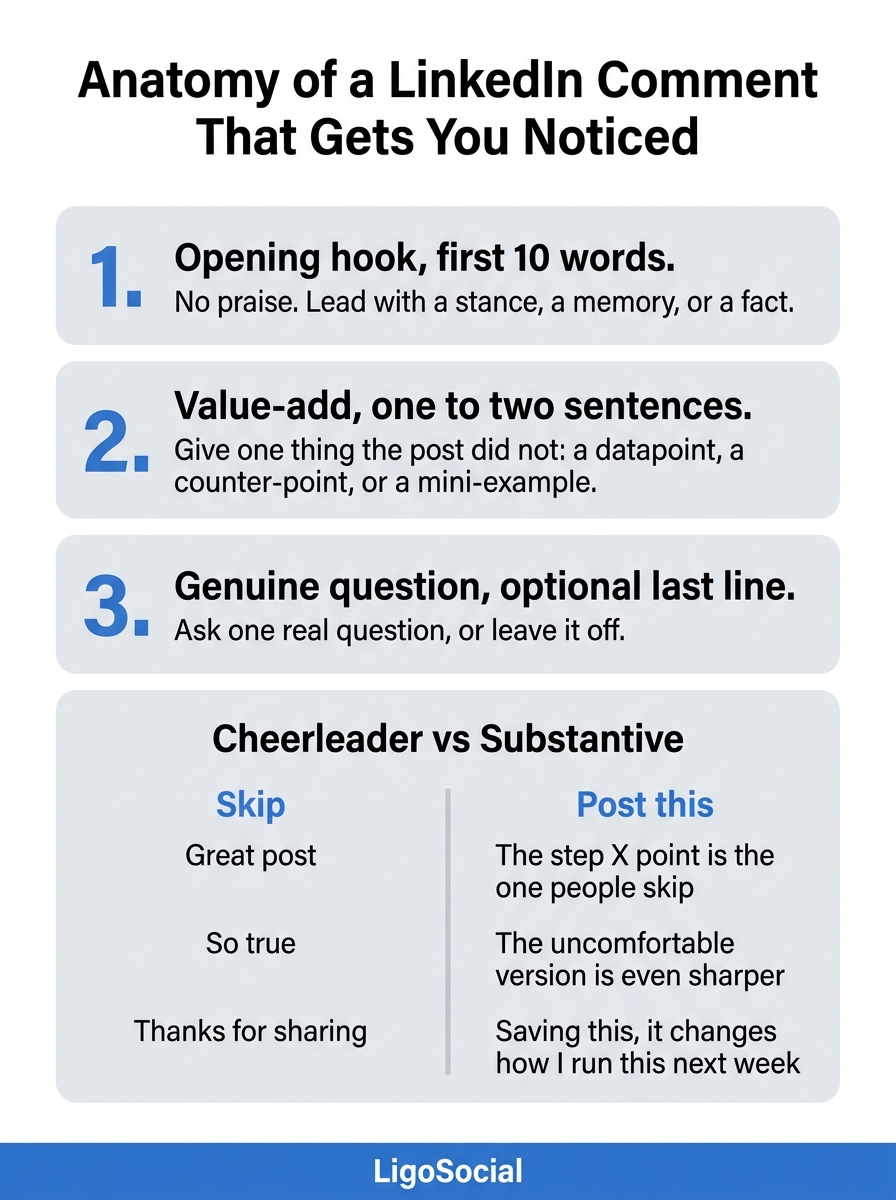
The anatomy of a comment that gets you noticed: hook, value-add, question, and the cheerleader lines to retire.
How to comment every day without burning out
Here is the real reason most people quit commenting: not effort, memory. You know you should engage, but the good posts scroll past, you forget who your best-fit accounts are, and the whole habit dies by week two. As I keep saying about LinkedIn growth, memory, not effort, is the real problem, and random commenting does not compound.
So build a system. Pick 30 minutes a day and 5 to 10 comments, only on posts whose audience overlaps your ideal customer. Keep three running lists: a handful of authority accounts, a peer group, and 15 to 20 potential clients. Comment where those people already gather.
This is exactly the workflow LigoSocial was built to make repeatable, and it is the one part of this article where a tool genuinely helps. Engagement Lists let you save any LinkedIn search as a one-click curated feed, so your best-fit posts are waiting for you instead of buried in the algorithmic scroll. Engagement Lists are free on every plan, store none of your LinkedIn data, and save most people 4 or more hours a month of hunting for something worth commenting on. Then, inside the LigoSocial Chrome extension, a comment co-pilot reads the post and suggests six drafts: three written in your own voice (it learns your tone from your past posts, so the suggestions sound like you and not a generic bot) and three optimized options. You pick one, edit it, and post it yourself. Nothing goes out without you. If you want to feel the voice match before installing anything, try the free LinkedIn comment generator or read how the comment generator writes in your voice.
The point is not to comment more. It is to comment on the right posts, in your voice, without the daily decision fatigue that kills the habit.
FAQ
What should I comment on a LinkedIn post?
Comment with one thing the post did not already say: a specific result from your own work, a respectful counter-point, a resource, or a genuine question that shows you read carefully. Avoid praise-only replies like "great post." A useful default is to affirm the author's core point in the first line, then add your datapoint or example, then ask one real question if you have one.
How do you write a good LinkedIn comment?
Use three parts. Open with a hook in the first 10 words that is a stance, a memory, or a fact rather than praise. Add value in one or two sentences with a datapoint, counter-point, or mini-example. Close with one genuine question, or leave it off if you do not have one. Keep it to 2 to 4 sentences, roughly 40 to 120 words, so it is long enough to add value and short enough to get read.
Are LinkedIn comments worth it?
Yes, and for busy founders they are often a better use of time than posting. A quality comment takes one to two minutes versus close to an hour for a good post, and it drops you in front of an audience that already exists. In my own tracking, commenting returned roughly 25 times the impressions per minute that posting did, and a two-week commenting-only test tripled my profile views. LinkedIn's 2026 feed also weighs genuine comments and dwell time more heavily than likes.
What are good short comments for LinkedIn?
Short works as long as it still adds something. "Agree, with one caveat: this only holds for [segment]" or "The [X] point is the one everyone skips" are short and specific. Avoid one to three word replies like "so true" or "love this", which read as filler and do little for your visibility.
How many LinkedIn comments should I leave per day?
Aim for 5 to 10 quality comments in about 30 minutes a day, all on posts whose audience overlaps your ideal customer. Volume without relevance does not compound. It is far better to leave 5 sharp comments in the right rooms than 30 generic ones scattered everywhere.
Is it OK to disagree in a LinkedIn comment?
Yes, and done well it is one of the best ways to get noticed, because respectful disagreement creates the back-and-forth the feed rewards. Challenge the idea, not the person, name the specific assumption you are questioning, bring a real counterexample, and end with a question. If the disagreement gets detailed or personal, move it to a direct message.
Your move
Commenting is the closest thing LinkedIn has to a free growth channel, and almost nobody works it on purpose. Pick three situations from the bank above, save the templates, and leave five real comments today on posts your ideal clients are already reading.
If you want the suggestions to sound like you instead of a bot, the LigoSocial Chrome extension learns your voice from your past posts and hands you six comment drafts to choose from, while Engagement Lists keep your best-fit posts in one place. You can start with 100 free credits, enough to test for about 7 to 14 days, no credit card. See current pricing when you are ready.
One question to leave you with, because I would genuinely like to know: which situation trips you up most, congratulating someone you barely know, or disagreeing without sounding combative? Tell me in the comments and I will send you a template for it.

