
LinkedIn Premium costs between US$39.99 and US$159.99 per month in the United States for the plans LinkedIn prices publicly, and there are now five paid tiers rather than the two most people assume. Every price below was checked on 13 August 2026 against LinkedIn's own pricing pages, not against a third-party blog.
This guide is for anyone staring at the upgrade prompt and trying to work out which tier, if any, is worth the money. It gives you the full comparison table, a plain decision framework, and the section the sales pages leave out: when to skip Premium entirely.
One thing worth naming up front. Google now answers "how much is LinkedIn Premium" with an AI summary that stitches together figures from several marketing blogs, and those figures disagree with each other. The table below is sourced from LinkedIn.
Key takeaways
- Premium Career is US$39.99 per month, or US$239.88 per year, which works out to US$19.99 per month.
- Premium Business is US$69.99 per month. Premium All-in-One, a newer combined tier, is US$89.99 per month.
- Sales Navigator Core is US$119.99 per month and is a separate product, not a Premium upgrade.
- LinkedIn does not publish a Recruiter Lite price on its public pages, so treat any figure you read elsewhere as an estimate.
- InMail credits are the honest difference between the tiers: 5, then 15, then 30, then 50 per month.
- If your problem is that nobody notices you, none of these plans fixes it.
What LinkedIn Premium costs right now
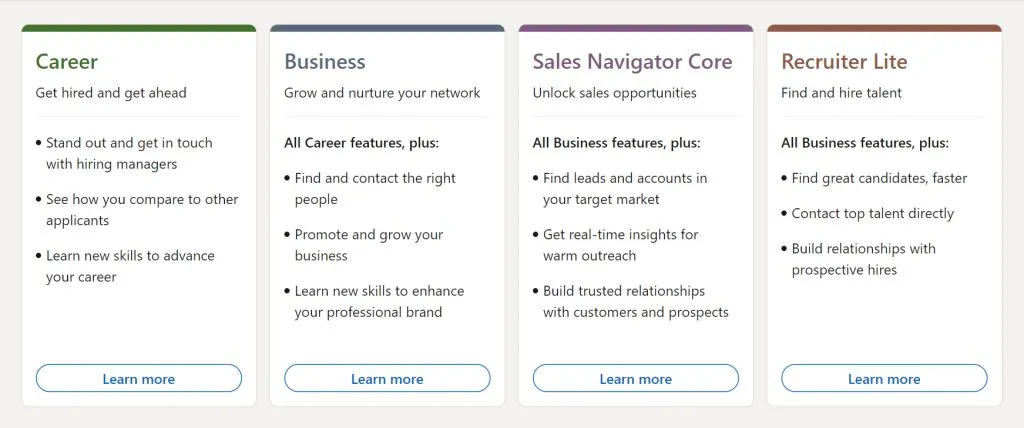
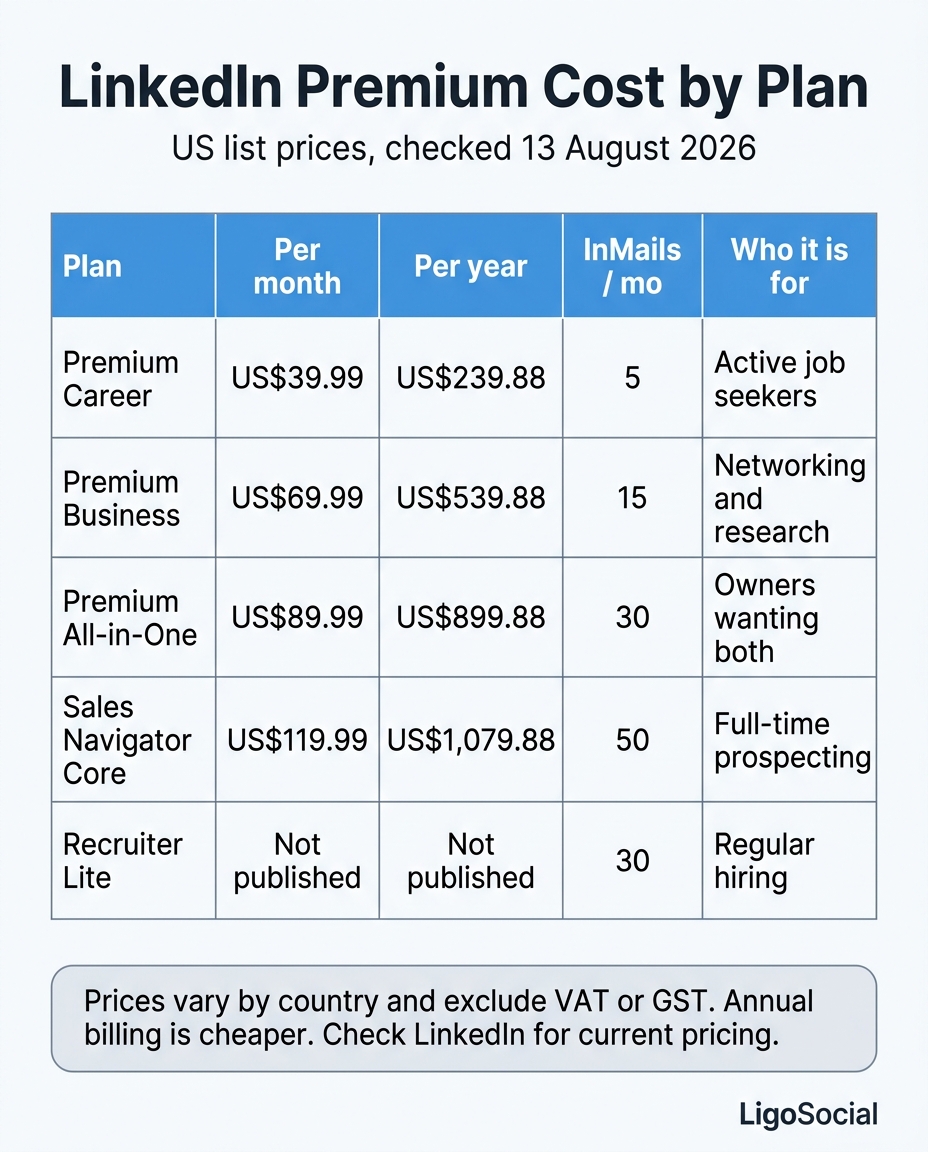
Here is every tier side by side, with US list prices as published by LinkedIn on 13 August 2026.
| Plan | Per month | Per year | Effective monthly on annual | InMails per month | Who it is actually for |
|---|---|---|---|---|---|
| Free (Basic) | US$0 | US$0 | US$0 | 0 | Almost everyone |
| Premium Career | US$39.99 | US$239.88 | US$19.99 | 5 | People actively job hunting right now |
| Premium Business | US$69.99 | US$539.88 | US$44.99 | 15 | Consultants and owners doing research and outreach |
| Premium All-in-One | US$89.99 | US$899.88 | US$74.99 | 30 | Owners who want the Career and Business features together |
| Sales Navigator Core | US$119.99 | US$1,079.88 | US$89.99 | 50 | Full-time sellers with a prospecting quota |
| Sales Navigator Advanced | US$159.99 | US$1,799.88 | US$149.99 | 50 | Sales teams needing team-level search and collaboration |
| Recruiter Lite | Not published publicly | Not published publicly | Not published publicly | 30 | People hiring on an ongoing basis |
Four caveats that matter more than the numbers themselves.
First, these are US list prices. LinkedIn publishes different figures per currency (Premium Career is £29.99 in the UK and €29,98 in the eurozone, for example) and its own pages note that prices "are estimates and may exclude Value-Added Tax (VAT), Goods & Services Tax (GST), and/or promotional discounts."
Second, annual billing is genuinely cheaper, and the size of the discount varies a lot by tier. LinkedIn describes Career annual as a 50% saving, Business annual as 36%, and All-in-One annual as 17%. That is a real spread, so do the division before you assume annual is always the smart buy.
Third, prices change. If you are reading this months after August 2026, verify on LinkedIn's own Premium pricing page before you commit.
Fourth, LinkedIn now sells "Duo" licences on some tiers (two seats billed together, for example US$59.98 per month for Career Duo). If you are buying for yourself and one other person, check whether Duo beats two singles.
Premium Career: only while you are actually looking
Premium Career is US$39.99 per month, or US$239.88 billed annually. For that you get 5 InMail credits per month, "Who's viewed your profile" with 365 days of history plus trends and anonymous browsing, AI-powered insights on job posts, an AI profile writing assistant, the ability to mark roles as a top choice job, and LinkedIn Learning access to 25,000+ courses.
The InMail credits are the part people misjudge. Five per month is one message to a hiring manager per working week. That is enough to be surgical and nowhere near enough to be a strategy. If you are planning to message fifty recruiters, Premium Career will not get you there.
The honest use case is narrow and time-boxed: you are applying to several roles a week, you can see recruiters viewing your profile, and you want the profile-view history to work out which companies are circling. Buy it monthly, use it hard for the two or three months of an active search, then cancel. Paying US$239.88 up front for a year of job hunting you hope will take eight weeks is a bad trade.
If profile views are the main thing pulling you toward Premium, read what you can and cannot see about your LinkedIn profile visitors first. The free account already shows you more than most people realise.
Premium Business and Premium All-in-One: the middle of the range
Premium Business is US$69.99 per month, or US$539.88 annually, with 15 InMail credits per month, unlimited profile browsing outside your network, and company insight data. It is aimed at consultants, freelancers and small business owners doing research and light outreach rather than volume prospecting.
Premium All-in-One is the tier most articles have not caught up with. It is US$89.99 per month, or US$899.88 annually, with 30 InMail credits per month, and it bundles the career-side and business-side features into one subscription. If you genuinely use both halves, it is cheaper than stacking. If you only wanted the Business half, it is US$20 a month of features you will not open.
The decision between Career and Business usually comes down to direction of travel. Career is built for being found and applying. Business is built for finding and approaching. If you are doing both, All-in-One exists for exactly that overlap. We have gone deeper on the middle tier in our breakdown of whether Premium Business earns its price.
Sales Navigator and Recruiter Lite: different products, not upgrades
This is the most common expensive misunderstanding. Sales Navigator and Recruiter are not higher rungs on the Premium ladder. They are separate products with their own interfaces, their own search, and their own contracts.
Sales Navigator Core is US$119.99 per month, or US$1,079.88 per year, with 50 InMail credits per month, advanced lead and account filters, saved lead lists and CRM syncing. Sales Navigator Advanced is US$159.99 per month, or US$1,799.88 per year, and adds team-level features. Advanced Plus is quoted per team rather than listed.
Recruiter Lite is the one place we will not give you a number. LinkedIn's own Recruiter Lite page confirms 30 InMail credits per month but does not publish a price, and the figures circulating in third-party guides vary by hundreds of dollars a year. Ask LinkedIn directly rather than budgeting from a blog post.
The test for whether Sales Navigator is worth US$1,079.88 a year is refreshingly simple. If one closed deal from it covers the subscription and you have a realistic pipeline, buy it. If you are hoping it will create the pipeline, it will not. If you are unsure which side of that line you are on, we compare the two head to head in Sales Navigator versus Premium and explain the product itself in what LinkedIn Sales Navigator actually does.
Pick this tier if
Match yourself to one line, not to the marketing.
- Premium Career, if you are applying to roles this month, you want 365 days of profile-view history, and you will cancel when you sign an offer.
- Premium Business, if you research companies and people weekly, and 15 InMails a month is roughly your real outreach volume.
- Premium All-in-One, if you are a founder or owner who is both hiring attention and looking for work or clients, and you would otherwise buy two subscriptions.
- Sales Navigator Core, if prospecting is in your job description, you have a quota, and you already know your ICP well enough to build a saved search.
- Sales Navigator Advanced, only if a team needs shared lists and team-wide search. A solo seller does not need it.
- Recruiter Lite, if you are filling roles continuously rather than once a year, and 30 InMails a month matches your outreach.
You probably do not need Premium if

This is the section the comparison sites will not write, because they are paid on the click through to checkout. Skip Premium if any of these describe you.
- You are not going to send the InMails. The credits are the product. If you will not write five thoughtful messages a month, you are paying US$39.99 for a profile-view list.
- You want to be seen, not to reach out. Premium adds almost nothing to your reach. Your posts and comments are what put you in other people's feeds, and those are free.
- You are hoping it boosts your job applications. The "top choice job" flag is a signal to a recruiter, not a ranking advantage in a queue. It helps at the margin, and only if the rest of your application is strong.
- You are between searches. Buy it for the eight weeks you need it. A dormant Premium subscription is the most common way people waste US$479 a year.
- Your profile is not finished yet. Paying for more visitors to an unconvincing profile is backwards. Fix the profile first with this lead-generation profile system, then decide whether you still need the upgrade.
For a large share of professionals, the correct answer really is the free account. That is not a hedge. It is what the feature list supports.
What Premium does not do, and what actually moves the needle
Here is the clean way to think about the whole category. Premium sells you visibility into other people: who looked, who else applied, who works where. It shows you who looked at you. It does not help you give them a reason to look.
That gap is not a pricing problem. It is a production problem. The people who get inbound on LinkedIn are the ones who show up in the feed consistently, and consistency is a system rather than a subscription. In practice the split is roughly 80% strategic commenting on other people's posts and 20% original posting, which is the opposite of how most people spend their LinkedIn time.
That split is the mechanism LiGo is built around. LiGo Lists save any LinkedIn search as a one-click curated feed so the twenty people worth replying to are in one place instead of buried in an algorithmic feed, and the comment co-pilot inside the LiGo Chrome Extension drafts six options for each post, three in your voice and three optimized, and you pick and post one. The voice half comes from LiGo Brain, a memory layer trained per profile with no cross contamination, which learns your tone, your topics and your stored opinions, and gets closer every time you edit what it hands you. It is a co-pilot, not a bot: LiGo uses LinkedIn's official OAuth API, and nothing goes out that you have not approved.
These are different categories, and it is worth being blunt about it. If you need to InMail a hiring manager who is outside your network, no content tool replaces Premium. If you need people to already know who you are before you message them, no Premium tier replaces posting.
FAQ
Is it worth it to pay for LinkedIn Premium?
It is worth it if you will use the InMail credits and the search depth in a specific window, such as an active job search or a quarter of heavy prospecting. It is not worth it as a standing subscription for general networking. The fastest sanity check: write down how many strangers you will message this month. If the answer is under five, the free account is enough.
What is the cheapest LinkedIn Premium plan?
Premium Career, at US$39.99 per month or US$239.88 per year in the United States. Billed annually that is US$19.99 per month, which LinkedIn describes as a 50% saving. It is the cheapest plan on every currency page LinkedIn publishes, though the local figure differs by country.
Is there a free trial for LinkedIn Premium?
Usually, but not automatically. LinkedIn's help pages say Premium subscriptions "may be available to try free for one month" and that "eligible users can try Premium for free," which means the offer is conditional on your account rather than guaranteed. Check the offer shown in your own account, and set a calendar reminder for the day before it renews.
How do I cancel LinkedIn Premium?
If you bought directly from LinkedIn, click the Me icon, select Premium features, open Manage subscription, go to Purchases, choose the active subscription and select Cancel subscription. If you subscribed through Apple's App Store or Google Play, you have to cancel in that store's subscription settings, not on LinkedIn. LinkedIn documents the full process in its cancel Premium help article.
Is there a cheaper way to get LinkedIn Premium?
Three legitimate routes: switch to annual billing (the saving ranges from 17% to 50% depending on tier), buy only during the months you will actually use it, and check whether a Duo licence beats two individual seats if you are buying for two people. Promotional offers do circulate through employers, universities, banks and mobile carriers in some countries, so it is worth checking benefits you already have before paying list price.
Is LinkedIn Premium free with Amazon Prime?
Not as a standard Prime benefit. LinkedIn does not list any Amazon bundle among its subscription options. Free or discounted Premium does get bundled by third parties in certain markets, usually by telecoms and banks, so read the terms of whichever specific offer you have found rather than assuming a general Prime perk exists.
The short version
LinkedIn Premium is a fair product with a narrow job. It buys you reach into people you are not connected to, and visibility into who is already paying attention. Priced against that job, US$39.99 a month for a focused eight-week job search is reasonable and US$479 a year for a subscription you forget about is not.
Decide with the table, buy monthly, use it hard, and cancel when the window closes. Then spend the attention you saved on the part Premium cannot do for you, which is being worth finding in the first place.
If the "being worth finding" half is where you are stuck, that is the problem LiGo works on. You can see the plans and start with 100 free credits, enough to test it for about 7 to 14 days, with no credit card required.
Prices in this article were verified against LinkedIn's own pricing pages on 13 August 2026. LinkedIn prices vary by country and by whether you buy monthly or annually, and they change without notice. LinkedIn is a registered trademark of LinkedIn Corporation and LigoSocial is not affiliated with, endorsed by, or sponsored by LinkedIn.