
You have rewritten your LinkedIn headline four times this month and it still reads like everyone else's. That is not a wording problem, it is a sequencing problem. Most people open the box and start typing, when almost all of the useful work happens before LinkedIn is even on screen.
Most guides on how to write a LinkedIn headline hand you a pile of finished examples and leave you to reverse-engineer the thinking. This is the build order instead: six steps, four copyable patterns, a rubric that scores your draft out of 10, and four before-and-after rewrites. It is written for people who sell (consultants, agency owners, freelancers, founders), not for people matching a recruiter's keyword filter. If you would rather browse finished lines first, our LinkedIn headline examples and formulas guide is the library. This piece is the workshop.
Key takeaways
- You get 220 characters, but only the front of the line survives in the places that matter most. Front-load the first 80.
- Do not write first. Collect four raw materials (who you help, the result, the proof, the differentiator), then assemble them.
- The words should come from your buyers, not from your job title. Your inbox and LinkedIn's own search bar are the source.
- Every headline worth reading has one detail nobody in your niche could copy without lying. That detail is what makes it stick.
- Score the draft against the 10-point rubric below before you publish. Under 5 out of 10 means go back to step one.
Where your headline actually shows up (and where it gets cut)
Your headline is not a profile field. It is your byline on the entire platform, riding along with your name in search, in comments, in connection requests, and in notifications. Most people meet your headline long before they meet your profile.
LinkedIn gives you 220 characters, and if you never write one it fills the slot with your current job title and company, which is the most forgettable thing it could say about you. The full 220 only ever render in one place.
| Where it appears | What people actually see | What that means for your draft |
|---|---|---|
| Your profile page | The full headline, all 220 characters | The only place the whole line lands |
| LinkedIn search results | A clipped line under your name | Assume roughly the first 80 characters are all you get |
| Comments you leave | A short byline beside your name | The first clause does all of the work |
| Connection requests | Your name plus a clipped headline | Give a reason to accept in the first few words |
| Notifications and message previews | Your name plus a clipped headline | Same rule, same first clause |
| A Google search for your name | The headline often lands in the result snippet | Write it so a stranger with zero context understands it |
LinkedIn publishes no exact truncation spec per surface, because the cut shifts with screen width and placement. The safe working assumption is that only the first 80 characters are guaranteed to be read. Everything after that is a bonus for people who already clicked.
Step 1: Collect your raw materials before you write a word
Most headlines sound generic because they are written inside a 220-character box, and a small box makes you reach for the nearest cliche. So do not open LinkedIn yet. Open a blank note and answer four questions at whatever length you want.
1. Who do you actually help? Not "professionals" or "businesses". A segment you could point at on a list: "home services companies doing $2M to $10M", "seed-stage B2B SaaS founders", "third-party logistics operators".
2. What changes for them? The result in outcome language, not activity language. "More booked jobs" beats "digital marketing services". "Stops overselling stock" beats "inventory optimization".
3. What proof can you point at? One number, one client type, one credential, one stretch of years. Something checkable.
4. What could nobody else in your niche claim? A constraint you enforce, an opinion you hold, a former life, a strange specialism. Hardest question here, and the one that does the most work.
Fill this in before you write anything:
I help ____________________________________ (segment, specific enough to point at)
to ________________________________________ (the result, in their words)
Proof: ____________________________________ (a number, a client type, a credential)
The thing nobody else can claim: __________ (a constraint, an opinion, a former life)
If any line takes you more than a minute, that is the line your headline is currently missing.
Step 2: Steal the exact words your buyers already use
Your headline has to be searchable and human at once, and both come from the same place: the language your buyers already use. You are not inventing vocabulary here, you are collecting it. Three sources, in order of value:
- Your last ten inbound conversations. Open the DMs and discovery-call notes and copy the exact phrasing people used for their problem. Not your summary of it. Their words. Highest-signal source you own, and almost nobody mines it.
- LinkedIn's own search bar. Type the phrase you think you own and read the first twenty headlines that come back. Nouns that repeat are terms the market recognises. Phrases that repeat so hard they have stopped meaning anything are the ones to avoid.
- Three job posts for the role that would otherwise hire you. Those are written in buyer language by definition. Take the nouns, leave the corporate padding.
The test for any phrase: would your buyer type it into a search bar? "Revenue operations" passes. "Growth architect" does not. Write in the words your buyer would type, not the words your industry uses internally.
Steps 3 and 4: Build the line, then break the pattern
Now you assemble. Two moves, and skipping the second is why so many headlines end up technically correct and completely forgettable.
Step 3: Build the line with one of four patterns
Pick the pattern that fits what you sell, then drop your Step 1 answers into it.
| Pattern | Template | Worked example |
|---|---|---|
| The plain claim | I help [segment] [result] | I help B2B SaaS founders turn one podcast a month into 20 posts |
| Role plus proof | [Role] for [segment]. [Proof] | Fractional CMO for seed-stage SaaS. Took three companies past $1M ARR |
| Problem first | [The problem they have]. [What you do about it] | Your best case study is buried in a PDF. I turn it into a pipeline |
| Narrow noun | [Very specific service] for [segment] | Shopify migration specialist for DTC brands doing $5M plus |
Any of those four gets you understood, which is more than most headlines manage. None of them gets you remembered, because a few thousand other people are already running the same scaffold.
Step 4: Break the pattern with one detail nobody can copy
Add one clause at the end that a direct competitor could not paste into their own headline without lying. That is the whole bar:
- A constraint: "Only take four clients at a time."
- An opinion: "I fix the process before the software."
- A former life: "Twelve years on factory floors before consulting."
- An honest limit: "I will tell you if you do not need one."
This is exactly where generic AI makes things worse. Ask a general-purpose model for a LinkedIn headline and it hands you the same "helping X achieve Y" scaffold it hands everyone, because it has never read a word you wrote. That gap is why LiGo Brain exists: it trains on your own past posts, your stored opinions, and your answers to its questions, per client profile with no cross-contamination between profiles, so what it drafts carries your phrasing instead of the average of the internet. If a blank box is the blocker, the free LinkedIn headline generator gives you options in seconds. Treat them as raw material for Step 4, never as the finished line.
For more scaffolds before you commit, the industry-specific headline formulas breakdown covers engineering, marketing, sales, healthcare, and finance variants, and the psychology behind effective headlines explains why the pattern break works at all.
Step 5: Score the draft before you publish it
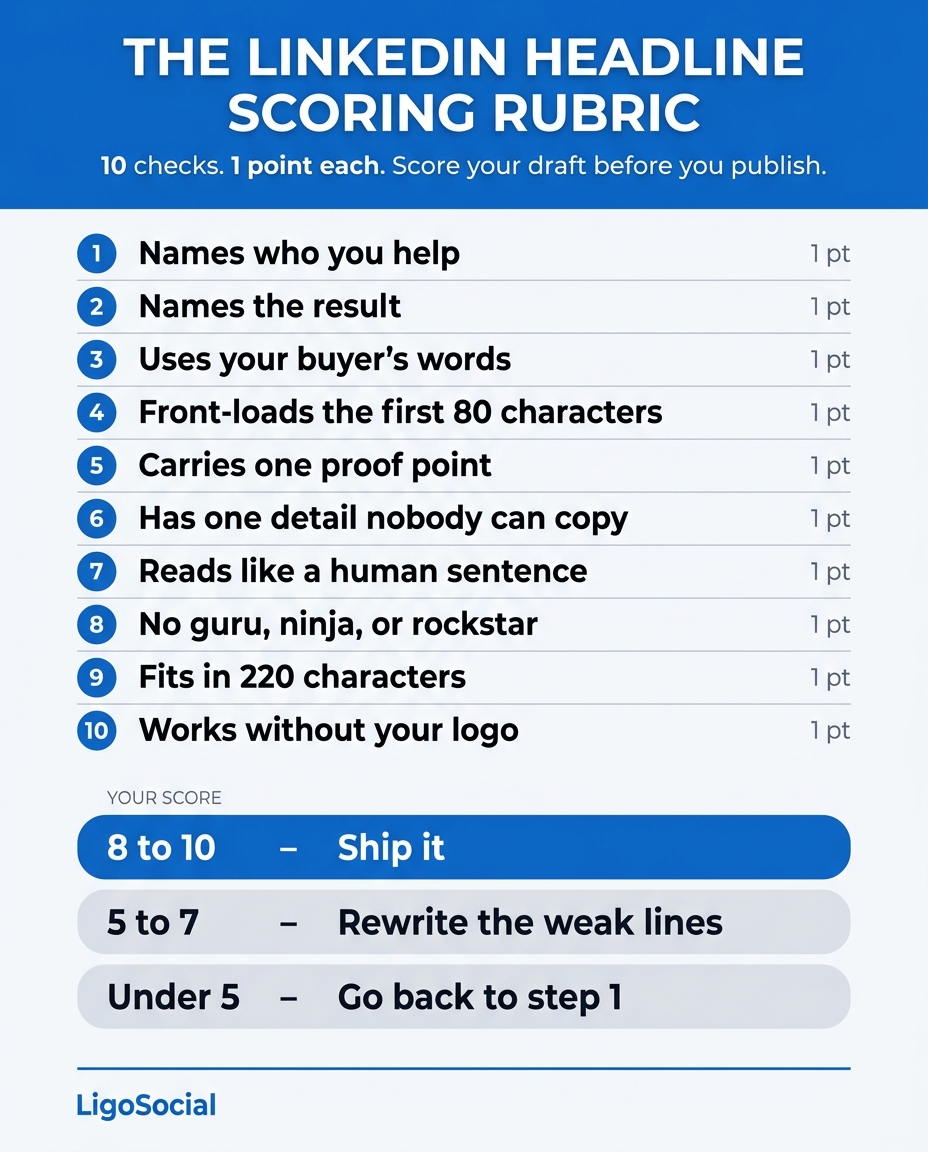
Most people publish a headline the moment it stops annoying them. That is a low bar. Score it instead: ten checks, one point each.
| # | Check | You get the point when |
|---|---|---|
| 1 | Names who you help | A specific segment appears, not "professionals" |
| 2 | Names the result | A stranger can tell what changes for them |
| 3 | Uses your buyer's words | Every noun survives being read aloud to a client |
| 4 | Front-loads the first 80 characters | Cover everything after character 80 and it still makes sense |
| 5 | Carries one proof point | A number, a client type, a credential, or a track record |
| 6 | Has one detail nobody can copy | A competitor could not paste it in without lying |
| 7 | Reads like a human sentence | You would say it out loud without wincing |
| 8 | No guru, ninja, or rockstar | Also no visionary, no thought leader, no "passionate about" |
| 9 | Fits in 220 characters | With room left over, not scraping the ceiling |
| 10 | Works without your logo | Someone who never heard of your company still gets it |
Read the score: 8 to 10 and you ship it. 5 to 7 and you rewrite the specific lines that failed. Under 5 and the problem is upstream, so go back to Step 1 rather than fiddling with word order.
Here is the whole rubric in one place, so you can score a draft without scrolling back.
Four before and after rewrites, with the reasoning
Patterns are easier to trust when you can see what changed. Each of these is a composite of headlines I see constantly, rewritten against the rubric above.
Agency owner
- Before:
Founder & CEO at Northbeam Digital | Digital Marketing Expert | Passionate About Helping Businesses Grow - After:
I help home services companies book more jobs from Google. 40+ HVAC and plumbing clients since 2019. No retainers under six months.
What changed: "businesses" became a segment you can picture, "grow" became a booked job, and the proof is checkable. The last clause is the pattern break, because a competitor who takes month-to-month work cannot copy it. Rubric score: 9 out of 10.
Freelance designer
- Before:
Graphic Designer | Branding | Logo Design | Available for Freelance Work - After:
Brand identity for B2B software that has outgrown its first logo. 60+ rebrands. I will tell you if you do not need one.
What changed: "available for freelance work" quietly announces that you are unbooked, which is the wrong thing to lead with. The rewrite opens with a narrow, searchable service and closes on an honest limit that reads as confidence.
Independent consultant
- Before:
Strategy Consultant | Ex-McKinsey | MBA | Helping Organizations Reach Their Full Potential - After:
Ops consultant for manufacturers doing $20M to $100M. Ex-McKinsey, eleven years on factory floors. I fix the process before the software.
What changed: the credentials survive, but now sit behind a segment and a revenue band, so they mean something. "Reach their full potential" was the only clause attempting to do work and it was doing none. The closing opinion is what people quote back to you on a call.
SaaS founder
- Before:
Co-Founder @ Trellis | Building the Future of Inventory Management - After:
Co-founder at Trellis. We keep 3PLs from overselling stock they do not have. Was a warehouse manager for six years, so I have made this mistake myself.
What changed: "building the future of" is a claim with no content in it. The rewrite says what the product prevents in the words an operator would use, and the founder story compressed into nine words is the only clause a competitor cannot lift.
The template gets you understood. The one detail nobody can copy gets you remembered.
For more finished lines by career stage, our LinkedIn headline examples piece has copy-ready versions for entry level through executive.
Step 6: Publish it, then check one number in 30 days
Changing it takes about twenty seconds (the exact desktop and mobile steps are in the FAQ below).
Now the part most headline advice skips: a headline only pays off if people encounter it, and the place yours gets seen most is not your profile. It is the comment section. Every comment you leave puts your name and that clipped first clause in front of an audience someone else already warmed up. This is why I treat strategic commenting as roughly 80 percent of the work and original posting as the other 20. A good headline plus ten targeted comments a day beats a perfect headline nobody ever runs into.
Doing that daily is a memory problem more than an effort problem. Nobody remembers which thirty people to check on every morning, which is why the habit collapses in week two. LiGo Lists let you save a LinkedIn search once and open that same curated list in one click every day. Random engagement does not compound. Repeated engagement with the right people does.
Thirty days later, look at one number: search appearances, which LinkedIn reports on your own profile. Read it against profile views:
- Search appearances up, profile views flat: keywords working, value line not.
- Profile views up, inbound flat: wrong segment paying attention.
- Both up: leave it alone for a quarter.
For the fuller picture of who is landing on you, who viewed your LinkedIn profile covers what that panel does and does not tell you. And once the headline is right, the About section is the next field worth this much attention, because that is where the click you just earned either converts or bounces.
Change one clause at a time, never the whole line, or you will never know which edit did it.
Start here. If a blank box is the blocker, the free LinkedIn headline generator gives you options in seconds with no signup, and you can run them straight through the rubric above. If you want everything you publish on LinkedIn to keep sounding like you rather than like a model, that is the job LiGo Brain does, training on your own writing per client profile and getting closer every time you edit its output. I am Junaid, and I built LiGo at Ertiqah after watching too many good operators lose to worse ones who simply showed up more consistently. Try it at ligosocial.com.
FAQ
How long can a LinkedIn headline be?
220 characters. That full length only renders on your profile page. In search results, comments, connection requests, and notifications the line gets clipped, so treat the first 80 characters as the part guaranteed to be read and put your segment and result there.
What makes a good LinkedIn headline?
Three things at once: it names who you help, it names what changes for them, and it carries one detail a competitor could not copy without lying. A headline doing all three is understood on the first pass and remembered on the second. Score any draft against the ten checks above before publishing.
How can I make my LinkedIn headline stand out?
Stop trying to sound impressive and get specific instead. A constraint ("only four clients at a time"), an opinion ("I fix the process before the software"), or a former life ("twelve years on factory floors") does more for recall than any adjective. Impressive is crowded. Specific is empty.
What is a catchy LinkedIn headline?
If you sell, catchy is the wrong target. Clever lines that hide what you do cost you the search traffic and the click. Aim for clear first, then add one memorable clause at the end. Clarity plus one surprising detail beats wordplay every time.
How do I change my LinkedIn headline?
On desktop, click the Me icon at the top of your homepage, click View Profile, click the Edit icon in your introduction section, edit the Headline field, then click Save. On mobile, tap your profile picture, tap View Profile, tap the Edit icon, edit the Headline field, then tap Save. There is no penalty for editing it, so iterate.
Should I put "Open to Work" in my LinkedIn headline?
If you are actively job hunting it can help, but lead with the role you want rather than your availability, because availability is not a reason to click. "Supply chain analyst, open to roles in Chicago" reads far better than a banner in front of your name. If you sell rather than job hunt, keep availability language out entirely. It signals a gap in your pipeline to exactly the people you want to win.