
You have posted consistently for three months and the calendar is still empty. The posts get likes from other coaches, a few kind comments, and zero discovery calls. That is not an ideas problem. It is an aim problem, and this guide fixes it with 30 specific posts, a copyable opening line for each, and a four week rotation you can start on Monday.
Written for solo coaches, consultants, and small advisory practices who sell a service and need the content to actually produce conversations.
Key takeaways
- Most post idea lists give you categories ("share a client win"), not posts. A category does not survive contact with a blank screen. A first line does.
- Every post that produces a call is aimed at a buying decision, not at engagement. Five objections stand between a reader and your calendar link, and each needs its own post.
- The rule that keeps this simple: one post, one objection, one proof. Posts that try to do all five say nothing.
- LinkedIn gives you 3,000 characters per post, confirmed on LinkedIn's own help pages. You will rarely want all of them.
- Ideas are the easy half. The hard half is remembering to publish and remembering who to engage with, which is a memory problem, not a motivation problem.
Why most post ideas for coaches never produce a call
Open any list of LinkedIn content ideas for consultants and you find the same ten buckets: client success, behind the scenes, myth busting, thought leadership, a personal story. They are not wrong. They are just not aimed.
A prospect who has read you for six weeks and still has not booked is not confused about whether you post. They are stuck on one of five specific questions:
- Does this person actually understand my problem, or are they generalizing?
- Has this worked for someone who looks like me?
- What is the catch, and what will this cost me beyond money?
- What does working together actually look like week to week?
- How do I start, and am I even the right fit?
A "behind the scenes" post answers none of those by default. The same post, written to answer question four, answers it cleanly. That is the whole shift: stop choosing a content category and start choosing an objection.
Lists also stop at the noun. "Share a client transformation" is a noun. You still have to write the first line, and the first line is where most posts die. Every idea below comes with an opener you can paste and finish.
The five posts every coaching or consulting offer needs
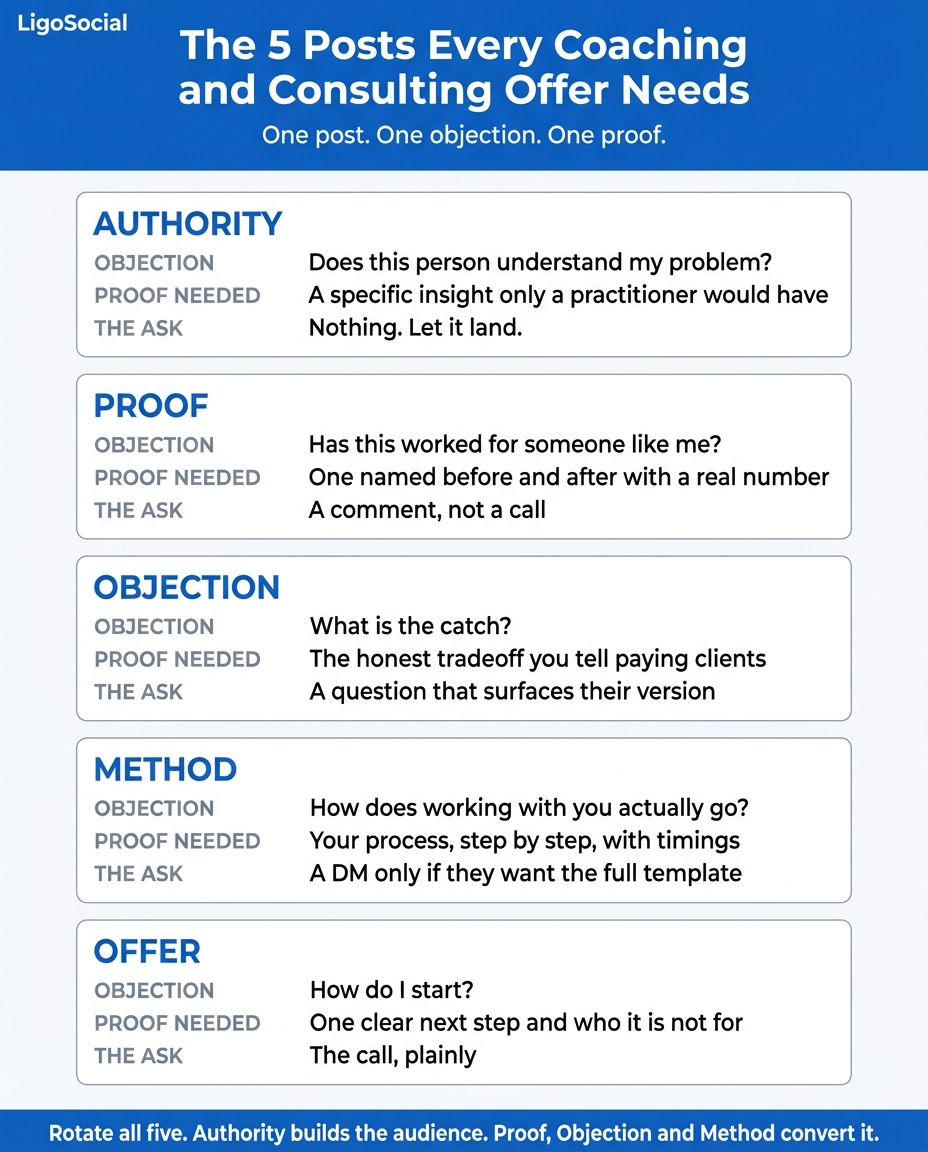
Each post type answers one objection, needs one kind of proof, and ends with one ask. Get all five running and you have a system, not a stream.
| Post type | The objection it answers | The proof it needs | What to ask for at the end |
|---|---|---|---|
| Authority | "Does this person understand my problem?" | A specific insight only a practitioner would have | Nothing. Let it land. |
| Proof | "Has this worked for someone like me?" | One named before and after with a real number | A comment, not a call |
| Objection | "What is the catch?" | The honest tradeoff you tell paying clients | A question that surfaces their version |
| Method | "How does working with you actually go?" | Your process, step by step, with timings | A DM only if they want the full template |
| Offer | "How do I start?" | One clear next step and who it is not for | The call, plainly |
Almost everyone runs Authority posts eighty percent of the time because they feel safest, then wonders why nobody books. Authority builds the audience. Proof, Objection, and Method convert it. Offer closes it.
You will notice two familiar types missing: the motivational quote post and the "what do you think?" question post. They earn comments and almost never earn calls, so keep them as garnish rather than a slot. If you want an audience question, put it at the end of an Objection post where it surfaces a real buying hesitation instead of a generic opinion.
30 LinkedIn post ideas for coaches and consultants
Six sets of five, mapped to the five post types plus a story set that feeds all of them. Each one has a copyable opening line. Replace the brackets with something specific and true, then write three to six short paragraphs underneath.
Authority posts (1 to 5)
- The diagnosis nobody makes. "Most [role] think their problem is [obvious symptom]. After [number] of these conversations, it is almost always [real cause]."
- The thing you stopped believing. "I spent [number] years telling clients to [common advice]. I do not anymore, and here is what changed my mind."
- The pattern across your last ten clients. "I looked back at my last ten [client type] engagements. Nine of them had the same thing in common."
- The question you always have to ask. "There is one question I ask in every first session, and the answer predicts almost everything: [question]."
- The term everyone uses wrong. "[Industry term] does not mean what most people think it means, and the misunderstanding costs [audience] real money."
Proof posts (6 to 10)
- The specific before and after. "When [client type] started, [specific metric] was [number]. Twelve weeks later it was [number]. Here is what we actually changed."
- The client who almost quit. "Six weeks in, [client] told me it was not working. Here is what we did instead of stopping."
- The unglamorous win. "No revenue number in this one. My client [did unglamorous thing] and it changed [outcome]. Not every win is a screenshot."
- The result you cannot take credit for. "A client got [result] and I had almost nothing to do with it. That is the part I want to talk about."
- The composite case study. "Three clients this year, same industry, same starting problem. Here is what worked for all three and what only worked for one."
Objection posts (11 to 15)
- The honest cost. "Working with me costs more than [alternative]. Here is exactly what you get for the difference, and when it is not worth it."
- Who this is not for. "I turned down [number] clients this quarter. Here is the profile I say no to and why saying yes would have hurt both of us."
- The timeline truth. "You will not see [outcome] in thirty days. Here is what actually happens in month one, month three, and month six."
- The thing they are afraid to ask. "The question I get in DMs but never in comments: [question]. Here is the unvarnished answer."
- The alternative you recommend. "If you are [situation], do not hire me. Do [cheaper or simpler thing] first. Come back when [condition]."
Method posts (16 to 20)
- The first session, step by step. "Here is exactly what happens in the first ninety minutes we work together, in order."
- The framework with a name. "I run every [engagement type] through the same four steps. I call it [name]. Step one is the one people skip."
- The tool or artifact. "Every client leaves session one with the same one page document. Here is what is on it."
- The between-sessions system. "The coaching is not the hour. It is the seven days between. Here is what I ask clients to do in those seven days."
- The way you measure. "I do not measure [vanity metric]. Here are the three things I track for every client and why."
Story posts (21 to 25)
- The moment you changed careers. "I was [previous role] when [specific moment]. That is the reason I do this work now."
- The failure that taught the method. "My first [number] clients got a worse version of what I do now. Here is what went wrong and what I rebuilt."
- The client who fired you. "A client ended our engagement early last year. She was right to. Here is what I learned."
- The thing outside work. "I learned more about [professional skill] from [unrelated activity] than from any certification."
- The season you almost quit. "Eighteen months in, I had [specific low point]. Here is what I would tell someone in that spot."
Offer posts (26 to 30)
- The plain invitation. "I have [number] spots opening in [month] for [specific client type]. Here is who it is for and how it works."
- The waitlist with a reason. "I am not taking new clients until [month]. If you want the next opening, here is what to do now."
- The free thing that qualifies. "I made [resource] for [audience]. It is free. If it helps, you will know whether working together makes sense."
- The results recap. "Here is what the last four [client type] achieved in ninety days. If that is the outcome you want, my calendar is open."
- The direct ask. "If you are a [client type] stuck on [problem], reply with the word [word] and I will send you [specific thing]."
Turn 30 ideas into a rotation you can actually run
The failure point is never supply. It is Tuesday, when you have a client at nine and nothing drafted. Here is a four week rotation that keeps all five post types circulating without you deciding anything on the day.
| Week | Monday | Wednesday | Friday |
|---|---|---|---|
| 1 | Authority | Proof | Story |
| 2 | Method | Objection | Authority |
| 3 | Proof | Story | Method |
| 4 | Objection | Authority | Offer |
That is twelve posts a month, one Offer post per cycle, and no week without proof. Repeat the grid and pull a fresh idea from the list above each time. The reference below lays out the same five types with the objection each answers and the ask each ends with, so you can keep it open while you write.
Deciding the grid once is the trick. The LinkedIn content calendar guide walks through the full schedule, and LinkedIn Content Ideas: A System to Never Run Out covers the capture habit that keeps the well full.
This is also the job Content Themes inside LiGo is built for. You define the two or three topics you want to be known for and the client you want to attract, and idea generation stays inside those lanes instead of drifting into generic advice. Consultants running more than one offer can set up more than one theme, which matters when you coach executives on Monday and founders on Thursday. Justin Welsh's content pillar approach is the same idea, and there is a short walkthrough on the LiGo channel: Use Content Pillars.
Make the posts sound like you, not like a coaching template
Coaching content on LinkedIn is interchangeable because everyone works from the same buckets in the same tone. Warm, encouraging, slightly abstract. It reads as safe, and safe does not get quoted.
Three things separate a post that sounds like you from one that sounds like the category:
- Name the specific. Not "a client in tech." A [role] at a [size] company who came to me because [exact sentence they said]. Specificity is the cheapest credibility there is.
- Keep an opinion in it. If nobody could disagree with your post, nobody will remember it. Objection posts are the easiest place to practice this because the honest tradeoff is inherently a stance.
- Write short. LinkedIn allows 3,000 characters per post, confirmed on LinkedIn's own help pages. Most coaching posts that land use well under a third of that. The first two lines are the only ones you are guaranteed to get read, which is why a first-line library like 30 first-line formulas is worth more than another idea list.
This is where generic AI falls down for coaches. Ask a general model for a LinkedIn post and you get the average of everyone's coaching content, which is the exact thing you are trying to escape. LiGo Brain works the other way around: it trains on your past posts, your profile, your stored opinions, and your answers to its questions, so drafts start from your phrasing rather than the internet's. It trains per client profile, each with its own independent voice model, which is what makes it usable if you write for your own practice and a client's brand from one account. Every time you edit a draft, it learns the edit.
The 20 percent nobody schedules
Here is the part most coaching content advice skips, and it is the part that actually fills a calendar.
The split we argue for at LiGo, from watching how solo practices actually win work, is roughly 80 percent strategic commenting, 20 percent original posting. It is a working thesis rather than a measured law, and here is the reasoning. A thoughtful comment on the post of someone your ideal client already follows puts you in front of a warmed audience you did not have to build. A post reaches the people who already follow you. Both matter. Only one compounds quickly when you are starting small.
Nobody hires a coach because the posts were consistent. They hire because one post named the exact thing keeping them stuck.
People skip it out of memory, not laziness. You cannot hold thirty target accounts in your head every morning, so you open LinkedIn, the feed serves whatever is loudest, and you engage with other coaches instead of buyers. Random engagement does not compound.
The fix is mechanical. Build one saved search of the people you want as clients, open it every morning, leave three real comments, close the tab. Ten minutes. The LiGo Chrome extension keeps those saved searches as one click lists in the sidebar and drafts comment options in your voice for you to pick from and edit, because LiGo is a co-pilot, not a bot. Nothing goes out that you have not read. Once that loop runs, your posts stop shouting into an empty room. More on the mechanics in LinkedIn for Consultants and 5 LinkedIn Post Ideas That Attract B2B Leads.
FAQ
What should a coach post on LinkedIn?
Five things, in rotation: authority posts that show you understand the problem, proof posts with one named result, objection posts that name the honest tradeoff, method posts that show how the work actually runs, and offer posts that make the next step obvious. If you only ever post authority and inspiration, you build an audience of peers instead of clients.
What is the 3-2-1 rule on LinkedIn?
It is not an official LinkedIn rule, and LinkedIn has never published one. It is community shorthand for a content mix, usually three educational posts, two personal or story posts, and one promotional post per cycle. Treat it as a starting ratio, not a law. The rotation above does the same job with more precision because it maps each slot to a buying objection rather than a vague category.
What is the 70/30 rule in coaching, and does it apply to my content?
In coaching practice, 70/30 refers to the conversation split in a session: the client talks roughly seventy percent of the time, the coach thirty. It is a facilitation heuristic, not a content rule. The useful translation to LinkedIn is that most of your words should be about the reader's situation and only a small share about you, which is why the openers above start with the reader's problem.
How often should a coach or consultant post on LinkedIn?
Three posts a week is the sweet spot for most solo practices, which is what the rotation above assumes. It is frequent enough that people recognize your name and sparse enough to keep every post specific. Three sharp posts beat five thin ones. If you can only sustain two, post twice and spend the recovered time commenting.
What makes a LinkedIn post stand out for a coaching audience?
A first line that names a situation precisely enough that the right reader thinks "that is me," followed by one idea developed properly instead of five listed. Add a real number, a real name, or a real quote from a session. Cut the summary paragraph that restates what you just said. Most posts improve when you delete the first two lines and the last two.
Start with one post, not thirty
Pick idea number 11 from the list, the honest cost post. It is uncomfortable, which is why almost nobody writes it, which is why it works. Write it today and watch who comments.
If drafting is the bottleneck rather than ideas, the free LinkedIn Post Generator will get you a first draft in your voice to edit down, and inside LiGo, Post Lab agents like Content Atomizer turn one long piece into a week of standalone posts while Opinion Miner surfaces the stances already sitting in your LiGo Brain. LiGo is built by Ertiqah for solo operators and agencies who use LinkedIn for pipeline rather than applause, and you can test the whole thing with 100 free credits, enough for about 7 to 14 days, no credit card.
Which of the five post types are you missing right now? For most coaches it is the objection post. That is usually the one that books the call.