
Last updated: July 2026
A LinkedIn launch post works best when it is not one post. The launches that actually move sign-ups run as a short sequence of 5 to 6 posts over roughly two weeks: an origin story with no pitch, a post on why you built the thing, the announcement itself, an offer-math post, and a customer-results post. This guide gives you copy-paste templates for each, the exact sequence and timing in a table, and the structure that decides whether any single post spreads or dies in the first line. It is written for founders, solopreneurs, and consultants launching a product, service, or offer to a warm-ish network, not for a brand posting a press release.
Key takeaways
- A launch is a sequence, not a single announcement. Plan 5 to 6 posts over about two weeks. One post spikes for 48 hours, then the interested-but-not-ready readers never hear from you again.
- Write five distinct angles: origin story (no pitch), why I built this, the announcement, the offer math, and customer results. Each one has a different job.
- The first two or three lines decide everything. LinkedIn cuts the feed preview off after the first few lines, so those lines exist only to earn the "see more" click, which is the event the algorithm watches.
- Lead with the reader's problem, not your company news. "We are excited to announce" is the weakest possible opening line.
- Reply to every comment yourself, fast. Early engagement in the first hour tells the algorithm whether to keep showing the post, so the comments are part of the launch, not an afterthought.
- End on a question, not a link. A close that invites a reply ("what would you add?") earns more reach than "DM me" or "click the link."
A launch post is a sequence, not one announcement
The single biggest mistake in every launch-post guide on the first page of Google is that they teach you to write one post. Then the numbers spike for two days, you go back to building, and the long tail of people who were interested but not ready to buy never sees anything again.
The fix is to treat the launch as a campaign of 5 to 6 posts spread over about two weeks. Each post does one job and hands the reader to the next. You warm the network with a story before you ever pitch, you make the announcement, you make the value math explicit, you prove it with a real result, and you close with a retrospective that keeps the product in the feed without selling.
Here is the sequence I ran when I launched LigoSocial's lifetime deal, mapped to timing and to the job each post does.
| Post | Its one job | When to post | Angle it uses |
|---|---|---|---|
| 1. Origin story (no pitch) | Warm the network and plant the story. Zero product mention. | Day -5 to -3 | Personal narrative |
| 2. Why I built this | Give the launch meaning: the problem, why now, why it matters to you. | Day -2 | Personal narrative / contrarian |
| 3. The announcement | It is live. What it is, who it is for, one clear next step. | Day 0 (launch day) | Before-and-after |
| 4. The offer math | Make the value undeniable with real numbers and the price logic. | Day 0 to +1 | Data-backed |
| 5. Customer results | Prove it with one real before-and-after and a number. | Day +3 to +5 | Before-and-after |
| 6. The retrospective | "Here is what actually happened." Keep the long tail warm without pitching. | Day +7 to +10 | Data-backed insight |
Notice that only two of the six posts are overtly promotional. That is deliberate. If every post is a pitch, the algorithm and your audience both tune out. The story and retrospective posts carry the reach; the announcement and offer-math posts convert the attention that reach earned.
The 5 launch posts to write (copy-paste templates)
These are angle-specific, not generic. Fill the brackets, keep the structure, and cut anything that does not earn its line. Each opens with a first line built to survive the "see more" cutoff.
1. The origin-story post (no pitch)
Its job is to make people care before you ask for anything. Do not mention the product. Pick the moment the problem became real for you.
Three years ago I [specific painful moment: lost a client / missed payroll / stared at a blank LinkedIn box for the tenth day straight].

I didn't know it yet, but that week is the reason [the thing you are about to launch] exists.

Here is what I got wrong first, and the small shift that fixed it:
- [wrong assumption 1]
- [wrong assumption 2]
- [the shift]

I'm sharing this because [the reader] is probably making the same call I did.

What did the early version of this problem look like for you?
2. The "why I built this" post
Post this a day or two before launch. It is vulnerable on purpose: it tells people the real reason, including the uncomfortable part.
I'm about to do something a lot of founders told me not to do: [the risky decision, e.g. run a one-time lifetime deal instead of a subscription].

Here is the honest reason.

[The constraint or belief driving it. For my LigoSocial launch, the reason was simple: I would rather have you own the tool for a fair one-time price than rent it forever.]

It might be the wrong call. But it is the one I can stand behind.

Tell me I'm wrong in the comments. I'll actually read them.
3. The announcement post (launch day)
Direct, but the first line is still about the reader's problem, not "we are excited to announce."
If you spend more time fighting [the tool / the process] than doing the work, this is for you.

[Product] is live.

It [does the one thing] so you can [get the one outcome], without [the pain the reader knows].

Who it's for: [specific reader].
What you do next: [one clear step, e.g. "comment 'LAUNCH' and I'll send the link" or "link in the comments"].

I'll be in the comments all day answering anything.
4. The offer-math post
This is where you make the value impossible to argue with. Use real numbers. When I launched, I laid the math out plainly: one payment against the yearly cost of every tool it replaced.
Let me show you the math, because it changed how I priced this.

[Product] replaces:
- [Tool A]: $[x]/yr
- [Tool B]: $[x]/yr
- [Tool C]: $[x]/yr

That is roughly $[total]/yr, every year.

[Product] is $[one-time price], once.

I did this because [the reason]. [Scarcity if it is real: "There are [N] seats left."]

Would you rather own the tool or rent it? Genuinely curious where you land.
5. The customer-results post
Proof beats claims. One real customer, one before, one after, one number. Get permission or anonymize.
[Customer or "one of our first users"] came in doing [the old painful way].

Two weeks later: [specific result with a real number, e.g. "profile views up, three inbound calls, one closed"].

Here is exactly what changed:
1. [change]
2. [change]
3. [change]

Nothing magic. Just [the mechanism].

If you're stuck at [the before state], what's the one thing keeping you there?
Every one of these ends with a question, not a link. That is not a stylistic quirk. A close that begs for an action ("DM me", "click here") asks the reader to leave the platform; a close that invites a comment keeps them on it, and comments are what the algorithm rewards with reach.
The structure that decides whether a post spreads
You can have the right angle and still die in the first line. Two frameworks fix that, and they stack.
Trailer, Meat, Summary. A post has three jobs in order. The Trailer is the first two or three lines, and its only job is to earn the "see more" click. LinkedIn truncates the feed preview after those lines, so that click is the conversion event the algorithm watches. Most founders lose here because they try to teach inside the Trailer, thinking the algorithm rewards depth. It does not see the depth if the post never opens. The Meat teaches one thing. The Summary closes with a Call to Conversation, not a Call to Action: a question that invites a reply.
Hook, Re-hook, Value, CTA. Inside that, label every post with four beats. The Hook is the scroll-stopping first line. The Re-hook is the one most posts skip: it makes the reader a promise about what they will know by the end, so they invest their attention past line one. Then the Value actually delivers it, and the CTA turns the attention into a follow or a comment. Skip a beat and you lose the reader at the exact point that beat was supposed to hold them.
Run both as a checklist before you post. If the Trailer is longer than three lines, cut. If the promise (the Re-hook) is missing, add it. If the close is a link, rewrite it into a question.

The two-week launch sequence: six posts, six jobs, only two of them overtly promotional.
Pick your angle before you write
Before you draft any post in the sequence, choose its archetype on purpose. Posts drift into "I don't know what this is supposed to be", which is the state most launch posts die in. There are five that reliably work:
- Personal narrative or story (best for the origin and why-I-built-this posts).
- Bold or contrarian opinion.
- "Here is how I solved X" tutorial.
- Before-and-after transformation (best for the announcement and customer-results posts).
- Data-backed prediction or insight (best for the offer-math and retrospective posts).
Each demands a different opening move: a moment, an opinion, a number, a contrast, or a forecast. Match the archetype to the post's job in the sequence and the first line writes itself.
If you want the underlying formatting to survive the feed (line breaks, scannable spacing, the "see more" fold), that is a separate craft. Our LinkedIn post formatting guide with templates and the pillar on why unformatted posts go invisible cover it, and the 30 first-line hook formulas give you Trailers to steal.
Running the sequence without it eating your week
Here is the honest problem: a six-post launch sequence written well, each one in your actual voice, is a lot of writing during the one week you are least able to spare it. This is exactly the job I built LigoSocial's Post Lab agents to carry.
Post Lab's Funnel Architect is a voice-trained agent that runs a 5 to 7 post campaign over roughly two weeks to test an offer, which is precisely a launch sequence. It drafts the origin story, the announcement, the offer-math post, and the follow-ups as one connected arc rather than six disconnected posts. Because it drafts through LigoSocial Brain, which learns your tone and opinions from your past posts, the sequence reads like you wrote it, not like a template. It runs in Manual, Co-Pilot, or Autopilot mode, and Autopilot defaults to saving drafts, so nothing goes out until you approve it. You can see the full agent lineup on the LinkedIn AI agents page, and if you just want to draft a single post fast, the free LinkedIn post generator is the place to start.
The tool writes the drafts. You still bring the story and reply to the comments. That order matters.
Launch day and after: the best practices that actually move the needle
The writing is half of it. These are the habits that decide whether the sequence converts.
| Do this | Why it works |
|---|---|
| Reply to every comment yourself, fast | The algorithm shows a new post to your followers plus some new people in the first hour. Weak early engagement throttles reach, so your replies are part of the distribution, not politeness. |
| Prime a few people before you post | A handful of genuine comments in the first 30 minutes signals the post is worth spreading. Tell three people it is coming. |
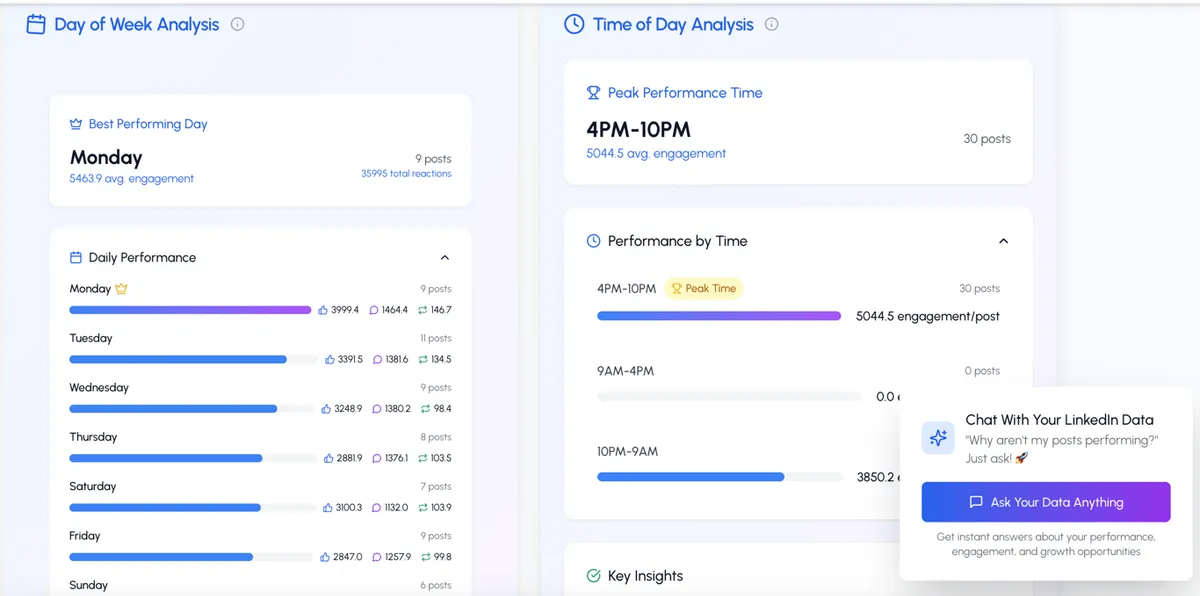
| Post when your audience is online | Mid-week mornings tend to work, but your own audience's active hours beat any universal "best time" rule. Check your analytics, then decide. |
| Lead with the reader's problem | "We are excited to announce" is the weakest opening on LinkedIn. Open on the pain the reader already feels. |
| Do not stop at the announcement | The retrospective post a week later ("here is what happened") converts the people who were not ready on day one, and the algorithm rewards it because people read it all the way through. |
The reply-to-every-comment habit is the one most people skip and the one that mattered most in my own launch. I answered every comment personally, in the first hour where I could, across the whole sequence. It is unglamorous and it works. For the full playbook on turning an announcement into pipeline, our guide on writing LinkedIn announcement posts that actually convert goes deeper on the follow-through.
FAQ
How do you announce a product launch on LinkedIn?
Announce it as a sequence, not a single post. Warm your network with an origin story a few days before, publish the announcement on launch day with the first line about the reader's problem (not "we are excited to announce"), follow it within a day with an offer-math post that makes the value explicit, then post a customer-results proof point a few days later. Keep every post to one job, lead with benefit, add one clear next step, and reply to every comment in the first hour.
What should a launch post say?
It should say, in order: who this is for, what problem it solves, what the thing is, and one specific next step. Open on the reader's pain, not your company news. Name the outcome the reader gets, keep it scannable with short lines, and close with a question that invites a comment rather than a link that begs a click. Save the detailed feature list for your landing page, not the post.
How many times should I post about a launch?
Plan 5 to 6 posts across about two weeks: an origin story before launch, a why-I-built-this post, the announcement, the offer-math post, a customer-results post, and a retrospective about a week after. That spread keeps the launch in the feed for the people who were interested but not ready on day one, which is where most of the conversions actually come from. Only two of those posts should be overtly promotional.
How long should a LinkedIn launch post be?
Long enough to do its one job and no longer, usually well under 300 words. What matters more than word count is the first two or three lines, because LinkedIn truncates the feed preview after them. Spend your effort on making that Trailer earn the "see more" click, then keep the body scannable with short paragraphs and line breaks.
What is the best first line for a launch post?
The one that names the reader's problem or a specific moment, not the one that announces your news. Compare "We are excited to announce our new tool" with "If you spend more time fighting your tools than doing the work, this is for you." The second stops the scroll because it is about the reader. Steal a proven opener from a hook formula bank, then make the second line a promise about what the reader gets by finishing.
Should a launch post include a link?
Keep the link out of the post body and put it in the first comment, or ask people to comment a keyword and send it to them. LinkedIn tends to suppress reach on posts that send people off-platform, and a comment-to-get-the-link mechanic doubles as early engagement. Close the post itself with a question, then drop the link where it does not cost you reach.
Your launch is a sequence. Start writing it.
The founders who get traction from a launch are not the ones with the cleverest single post. They are the ones who show up for two weeks with a story, an offer, and a proof point, and who answer every comment like it matters. Write the six posts, pick an angle for each on purpose, and lead every one with the reader instead of yourself.
If drafting all six in your own voice is the part that stalls you, that is the exact job Post Lab's Funnel Architect was built for: see how the LinkedIn AI agents run a launch campaign, starting with 100 free credits, enough to test for about 7 to 14 days, no credit card.
So here is my question back to you: what is the one post in that sequence you have been avoiding writing, and why?