
Der Schlüssel zum LinkedIn-Erfolg ist nicht nur Präsenz – es ist Engagement. Diese 25 wirkungsstarken Post-Ideen wurden speziell für Agenturinhaber, Gründer und vielbeschäftigte Fachleute entwickelt, die ihre LinkedIn-Präsenz aufbauen möchten, ohne Stunden in die Content-Erstellung zu investieren.
Warum LinkedIn-Engagement 2025 wichtig ist
LinkedIn entwickelt sich weiter als die führende Plattform für professionelles Networking und Thought Leadership. Mit über 1 Milliarde Nutzern erfordert es strategische Inhalte, um herauszustechen, die zu bedeutungsvoller Interaktion anregen.
Der LinkedIn-Algorithmus bevorzugt 2025 stark Inhalte, die Kommentare, Shares und längere Verweildauer erzeugen. Tatsächlich posten nur 1 % der LinkedIn-Nutzer regelmäßig Inhalte – das bedeutet, dass diejenigen, die konsequent wertvolle Einblicke teilen, überproportionale Sichtbarkeit und Einfluss gewinnen.
Für Agenturinhaber und Gründer ist das eine bedeutende Chance, Autorität aufzubauen, Kunden zu gewinnen und Thought Leadership zu etablieren – alles durch konsistentes, strategisches Posten.
Textbasierte LinkedIn-Posts, die Engagement erzeugen
1. Der ehrliche Story-Post
Authentizität kommt auf LinkedIn besonders gut an. Teilen Sie echte Geschichten aus Ihrem beruflichen Werdegang, einschließlich Herausforderungen und Misserfolgen.
Beispiel:
I made a critical mistake that almost cost us our biggest client.

Here's what happened:
We rushed the development process for a key deliverable, skipping our usual QA steps to meet a tight deadline. The result? A product with major issues that the client discovered during their first use.

The lesson I learned:
No deadline is worth damaging trust. Quality control processes exist for a reason, and shortcuts inevitably lead to longer recovery paths.

How I applied it:
We implemented a "minimum QA threshold" policy that cannot be bypassed, even for our most urgent projects. We also became more transparent with clients about realistic timelines.

The surprising outcome? Clients respect our commitment to quality and now give us more reasonable deadlines.

Have you faced a similar challenge? How did you handle it?
2. Blick hinter die Kulissen
Menschen lieben es, den Prozess hinter polierten Ergebnissen zu sehen. Geben Sie Einblicke in die Abläufe Ihrer Agentur, die Projektentwicklung oder den Arbeitsalltag.
Beispiel:
Here's what most people don't see about running an agency:

[Photo of whiteboard covered in post-its and diagrams]

The reality is:
For every polished case study we share, there are dozens of messy brainstorming sessions, failed concepts, and late nights reworking ideas.

This is our creative process for a recent client project - complete with coffee stains, illegible notes, and occasional moments of brilliance.

But it's worth it because:
This chaos is where the real magic happens. These messy explorations lead to the insights that transform decent work into exceptional results.

What does your behind-the-scenes process look like?
3. Expertentipps und Thought Leadership
Positionieren Sie sich als Autorität, indem Sie wertvolle Erkenntnisse teilen, die Ihr Publikum weiterbilden.
Beispiel:
3 things I've learned about client onboarding after 10 years in the agency business:

1. Documentation beats conversation. No matter how good your kick-off call is, clients remember less than 30% of what's discussed. Provide a clear, visual onboarding guide they can reference.

2. Set expectations about response times immediately. We clearly state that emails are answered within 24 hours, urgent matters get same-day responses, and emergencies have a dedicated phone number.

3. Early wins build momentum. Structure your first deliverables to provide quick, visible value rather than focusing solely on foundational work that clients can't "see."

The biggest mistake I see most agencies make is:
Treating onboarding as administrative rather than strategic. Those first 14 days set the tone for the entire client relationship.

Instead, try this:
Design your onboarding as a premium experience with clear milestones, expectations, and opportunities for the client to feel heard and valued.

What onboarding practices work best for your business?
4. Frage-Posts
Fragen fördern Engagement, indem sie das Publikum ausdrücklich zur Beteiligung einladen. Der Schlüssel ist, Fragen zu stellen, die leicht zu beantworten, aber dennoch zum Nachdenken anregend sind.
Beispiel:
What's one tool your agency couldn't function without?

I'll go first: We'd be lost without Notion. It's become our central operating system for project management, client documentation, process workflows, and even our company handbook.

Asking because we're evaluating our tech stack and would love to discover what's working for others. Especially interested in hearing from agencies with 5-20 team members.

(Bonus points if you share WHY it's so essential to your workflow!)
5. Branchenprognosen und Trendanalysen
Teilen Sie Ihre Vorhersagen darüber, wohin sich Ihre Branche entwickelt, um vorausschauendes Denken zu demonstrieren.
Beispiel:
3 predictions for digital marketing agencies in 2025:

1. The generalist agency model will continue to struggle. Clients increasingly prefer specialists who demonstrate deep expertise in one area rather than adequate skills across many.

2. AI integration will become a competitive requirement, not a differentiator. Agencies that haven't built AI-enhanced workflows will face margin pressure from more efficient competitors.

3. Direct client relationships will become more valuable than ever. As project work becomes increasingly commoditized, retained strategic partnerships will be the most sustainable revenue model.

What I'm personally preparing for:
We're narrowing our service offerings by 30% this year to deepen our expertise in conversion optimization and customer journey mapping.

What industry trends are you seeing that others might be missing?
Visuelle Inhalte, die Aufmerksamkeit erregen
6. Carousel-Posts
Carousel-Posts (PDF-Slides) erhalten höheres Engagement, weil sie mehr Bildschirmfläche einnehmen und zum Wischen anregen.
Beispiel – „5 Strategien zur Kundengewinnung, die 2025 funktioniert haben":
-
Slide 1: Titelfolie mit einer aufmerksamkeitsstarken Statistik zu Kundenakquisitionskosten
-
Slide 2: Strategie Nr. 1 – „Community-First-Ansatz" mit konkreten Umsetzungsschritten
-
Slide 3: Strategie Nr. 2 – „Wertorientierte Content-Partnerschaften" mit Fallstudien-Zusammenfassung
-
Slide 4: Strategie Nr. 3 – „Mikro-Spezialisierung" mit Beispielen erfolgreicher Agenturen
-
Slide 5: Strategie Nr. 4 – „Hybride Produkt-Service-Angebote" mit Umsetzungs-Framework
-
Slide 6: Strategie Nr. 5 – „Strategisches Unbundling" mit Vorher-Nachher-Vergleich
-
Slide 7: Ergebniszusammenfassung mit Kennzahlen und Call-to-Action
Profi-Tipp: Fügen Sie auf der ersten Folie ein klares Inhaltsverzeichnis ein und beenden Sie das Carousel mit einer spannenden Frage, um Kommentare anzuregen.
7. Native Video-Inhalte
Videos performen auf LinkedIn außergewöhnlich gut, besonders wenn sie nativ hochgeladen und nicht von externen Plattformen verlinkt werden.
Beispiel – 90-sekündige Kundenerfolgsgeschichte:
-
0:00–0:10: Stellen Sie die Herausforderung des Kunden vor (mit Text-Overlay, das das Problem zusammenfasst)
-
0:10–0:25: Erklären Sie Ihren Ansatz (mit einfachen Visuals oder Grafiken zu den wichtigsten Schritten)
-
0:25–0:45: Teilen Sie konkrete Ergebnisse mit Kennzahlen (nutzen Sie Bildschirmtext, um Zahlen hervorzuheben)
-
0:45–0:70: Fügen Sie ein kurzes Kunden-Testimonial ein
-
0:70–0:90: Fassen Sie die wichtigsten Erkenntnisse zusammen und schließen Sie mit einem Call-to-Action
Denken Sie daran: Fügen Sie immer Untertitel hinzu, da die meisten LinkedIn-Videos ohne Ton angesehen werden, und halten Sie Videos unter 2 Minuten für maximales Engagement.
8. Infografiken und Datenvisualisierungen
Visuelle Darstellungen von Daten oder Konzepten performen gut, weil sie komplexe Informationen schnell vermitteln.
Beispiel – „Vergleich von Agentur-Preismodellen":
-
Erstellen Sie einen visuellen Vergleich verschiedener Preisstrukturen (stundenbasiert, projektbasiert, Retainer, wertbasiert, erfolgsbasiert)
-
Fügen Sie für jedes Modell hinzu:
-
Durchschnittliche Gewinnmarge
-
Kundenzufriedenheitswert
-
Teamzufriedenheitswert
-
Am besten geeignete Projekttypen
-
Wichtigste Vor- und Nachteile
-
-
Ergänzen Sie die Perspektive und Erfahrung Ihrer Agentur mit jedem Modell
-
Fügen Sie Ihr Logo und eine klare Quellenangabe für die Daten hinzu
Interaktive Inhalte, die das Engagement steigern
9. Umfrage-Posts
Umfragen erzeugen hohes Engagement, weil sie für Ihr Publikum schnell und einfach zu beantworten sind. Laut Social-Media-Experten sind sie eine der einfachsten Möglichkeiten, Engagement-Kennzahlen zu steigern.
Beispiel:
Agency owners: What's your biggest operational challenge right now?

- Finding and retaining talent
- Maintaining consistent lead generation
- Managing scope creep and profitability
- Scaling processes and systems

Share your specific challenge in the comments - I'll compile resources for the top issues!
10. „Dies oder das"-Posts
Präsentieren Sie zwei Optionen und bitten Sie Ihr Publikum, sich zu entscheiden und die Gründe zu erläutern.
Beispiel:
Agency owners: Remote team or in-office?

I've tried both models, and here's what I've learned:

Remote pros: Wider talent pool, lower overhead, happier team
Remote cons: Communication challenges, culture building takes more intention

In-office pros: Spontaneous collaboration, stronger culture, easier onboarding
In-office cons: Location limitations, higher costs, commute burnout

We've settled on a hybrid model with quarterly in-person gatherings, and it's working well for us.

What's working better for your agency, and why? Reply with "remote" or "in-office" and share your experience.
11. Dokument-Posts
Das Teilen wertvoller Ressourcen als herunterladbare Dokumente kann sofortigen Mehrwert bieten und gleichzeitig das Engagement steigern.
Beispiel – „Checkliste für das Kunden-Onboarding":
-
Erstellen Sie eine professionell gestaltete einseitige Checkliste im PDF-Format
-
Fügen Sie die wichtigsten Schritte vom ersten Vertrag bis zur ersten Lieferung ein
-
Ergänzen Sie hilfreiche Tipps auf Basis der Erfahrung Ihrer Agentur
-
Versehen Sie sie mit Ihrem Logo und Ihren Kontaktdaten
-
Laden Sie sie als Dokument-Post hoch, mit einer Beschreibung, wie sie Ihrer Agentur geholfen hat
-
Fügen Sie einen Call-to-Action für Feedback oder weitere Vorschläge ein
Authentische Inhalte, die Verbindung schaffen
12. Posts über persönliche Erfolge
Teilen Sie berufliche Meilensteine oder Erfolge und konzentrieren Sie sich dabei auf den Weg und die gewonnenen Erkenntnisse statt nur auf die Leistung selbst.
Beispiel:
Today marks 5 years since I started [agency name].

What I thought it would be like:
Building an agency would mean creative freedom and choosing ideal clients.

What it's actually been like:
A masterclass in resilience, adaptability, and building systems. Creative freedom came much later than expected.

3 biggest lessons learned:
1. Profitability enables purpose. Without sustainable margins, you can't pursue the work that matters.
2. Culture happens by design or by default. Intentional values beat accidental ones every time.
3. Your team's growth ceiling becomes your agency's growth ceiling. Invest in developing your people.

To everyone who's been part of this journey:
The clients who took a chance on us, the team members who brought their best work, and the mentors who guided us through tough decisions - thank you for being part of this story.

Here's to the next five years!
13. Dankbarkeits- und Anerkennungs-Posts
Die öffentliche Anerkennung von Teammitgliedern, Kunden oder Partnern schafft Wohlwollen und fördert Engagement.
Beispiel:
I need to spotlight someone who's making a huge difference:

Sarah from our design team has just completed her 50th client project with us, and the client feedback has been extraordinary.

What makes this special is:
Beyond the stunning design work, Sarah has pioneered our new client collaboration process that's reduced revision rounds by 40% and improved satisfaction scores.

She's the embodiment of our value that "great work solves problems, not just looks good."

@Sarah-thank you for raising the bar for all of us. Your attention to both aesthetics and results is what makes clients continue to choose us.

Who on your team deserves recognition today?
14. Posts über die Gründerreise
Dokumentieren Sie Ihre unternehmerische Reise und teilen Sie sowohl Herausforderungen als auch Erfolge.
Beispiel:
Year 1 of building my agency:
Working 80-hour weeks, saying yes to every project, and pricing too low. Constant anxiety about cash flow.

Year 3:
Found our niche, developed repeatable processes, built a core team. Still working too much, but with greater impact.

Year 5:
Clear positioning, healthy margins, and a leadership team that runs daily operations. Finally taking vacations without checking email.

The one constant has been:
The need to continuously reinvent ourselves. Every time we get comfortable, the market shifts, and we need to evolve.

For those just starting out:
The challenges change, but they never stop. The difference is that you get better at solving them, and more confident in your ability to figure things out.

What stage are you in your business journey?
Lehrreiche Inhalte, die Mehrwert bieten
15. Schritt-für-Schritt-Anleitungen
Zerlegen Sie branchenrelevante Prozesse in klare, umsetzbare Schritte.
Beispiel:
How we onboard new clients in 5 steps:

1. Discovery workshop: A structured 90-minute session to identify goals, constraints, and success metrics. We use a specific template that ensures we capture all critical information.

2. Roadmap development: We create a visual project roadmap that shows deliverables, dependencies, and client touchpoints. This becomes our shared reference point.

3. Resource allocation: Our project management system automatically assigns team members based on project requirements and current capacity. Clients get introduced to everyone involved.

4. Kickoff meeting: A 60-minute call to review the roadmap, confirm communication protocols, and establish success metrics. We record this for anyone who can't attend.

5. Welcome package delivery: Clients receive a digital welcome package with team bios, communication guidelines, and a custom-branded project dashboard.

This process has helped us reduce project delays by 35% and increase client satisfaction scores from 8.2 to 9.6/10.

What does your onboarding process look like? Is there a step you'd add to our approach?
16. Mythos-vs.-Realität-Posts
Entkräften Sie verbreitete Irrtümer in Ihrer Branche, um Autorität aufzubauen und Diskussionen anzuregen.
Beispiel:
3 myths about agency growth that need to die:

Myth 1: You need to continuously add services to grow
Reality: The most profitable agencies often do fewer things exceptionally well. Depth beats breadth for premium positioning.

Myth 2: More clients equals more profit
Reality: Client concentration isn't always bad. Our most profitable year came when we served fewer clients at higher retainer values.

Myth 3: You need a sales team to scale past $1M
Reality: Many 7-figure agencies operate with founders as the only sales function, supported by strong marketing systems that qualify prospects.

What myths have you encountered (or believed) in your business journey?
17. Ressourcen-Zusammenstellungen
Teilen Sie wertvolle Tools, Artikel oder Ressourcen, die Ihr Publikum hilfreich finden würde.
Beispiel:
5 tools that transformed our agency operations this year:

1. Loom: Reduced our meeting time by 30% by enabling asynchronous video updates and client feedback.

2. Notion: Centralized our knowledge base, client documentation, and process workflows in one searchable hub.

3. LiGo: Streamlined our LinkedIn content creation with AI-powered templates tailored to our agency's voice.

4. Riverside: Elevated our podcast production quality without requiring technical expertise from our team.

5. Calendly with Zapier: Automated our meeting scheduling and preparation workflows, saving 5 hours weekly.

Combined, these tools save our team approximately 25 hours per week compared to our previous systems.

What tools would you add to this list? What's made the biggest impact on your operations?
18. Fallstudien und Erfolgsgeschichten
Teilen Sie konkrete Beispiele dafür, wie Sie Kunden zu Ergebnissen verholfen haben.
Beispiel:
How we helped a SaaS startup increase trial-to-paid conversion by 72%:

The challenge:
A B2B SaaS company was struggling with a 4% trial-to-paid conversion rate, well below industry benchmarks.

Our approach:
1. Conducted user journey mapping to identify friction points
2. Redesigned the onboarding email sequence based on user behavior
3. Implemented targeted in-app guidance for key features
4. Created a "quick win" dashboard to show immediate value

The results:
▪️ Trial-to-paid conversion increased from 4% to 6.9% in 30 days
▪️ New user feature adoption rose by 41%
▪️ Time-to-first-value reduced from 3 days to 47 minutes
▪️ Overall revenue impact: $267,000 in additional ARR

Key takeaway:
Users don't convert because they've seen all your features. They convert because they've experienced value quickly in a way that matters to their specific needs.

What's your approach to improving conversion rates?
Inhalte, die Expertise demonstrieren
19. Frameworks und Methoden
Teilen Sie eigene Frameworks oder Methoden, die Ihren einzigartigen Ansatz für häufige Herausforderungen zeigen.
Beispiel:
After working with 50+ agencies on their positioning, I've developed what I call the "CAMPS" framework for agency differentiation:

C - Category: Define the specific service category you dominate
A - Audience: Identify the narrow client segment you serve best
M - Methodology: Articulate your unique approach or process
P - Proof: Showcase tangible results and social validation
S - Story: Connect your positioning to a compelling narrative

The most common mistake? Agencies try to differentiate on quality or service alone - attributes every competitor also claims.

Instead, combine audience specificity with a proprietary methodology for the strongest positioning.

I've attached a one-page PDF guide to implementing this framework. What element do you find most challenging?

[Attached PDF: CAMPS Framework Implementation Guide]
20. Datenbasierte Erkenntnisse
Teilen Sie eigene Forschung, Datenanalysen oder Branchen-Benchmarks, die Ihrem Publikum wertvolle Einblicke liefern.
Beispiel:
We analyzed 187 agency websites to understand how positioning affects lead generation results.

Key findings:

1. Industry specialization correlates with 3.2x higher conversion rates compared to service specialization.

2. Agencies with case studies showing specific metrics generate 47% more leads than those with visually-focused case studies.

3. Counter to popular advice, agencies with the highest lead generation don't talk about "why" they do what they do - they focus relentlessly on client results.

4. The sweet spot for service offerings: 3-5 core services. Agencies offering 6+ services saw 28% lower conversion rates.

5. Websites with pricing information (even ranges) generated 2.9x more qualified leads.

Most surprising finding: "Full-service" agencies had the lowest lead-to-client conversion rates despite often generating high website traffic.

Want the full research report? Drop a comment, and I'll share it with you.
21. Trendanalysen und Prognosen
Analysieren Sie Branchentrends und geben Sie durchdachte Vorhersagen darüber ab, wohin sich Ihre Branche entwickelt.
Beispiel:
5 agency trends I'm watching closely in 2025:

1. The unbundling of agency services into specialized "micro-agencies" focused on high-value niches. We're already seeing 2-3 person teams generate $500K+ by serving a single vertical with a single solution.

2. The rise of hybrid pricing models that combine fixed scope with performance incentives - especially in marketing and growth-focused partnerships.

3. Investment in proprietary technology as a competitive moat. Agencies creating custom tools are commanding 30%+ higher project rates.

4. Increased collaboration between specialized agencies through formal networks, allowing them to compete with larger full-service agencies.

5. The commoditization of execution-only services, with premium positioning requiring strategic advisory components.

I'm particularly interested in #4 - we're exploring partnerships with complementary agencies to offer clients comprehensive solutions without sacrificing our specialist positioning.

Which of these trends are you experiencing or preparing for?
22. Branchenberichte und Daten
Teilen Sie Erkenntnisse aus relevanten Branchenberichten zusammen mit Ihrer Analyse, was die Daten für Ihr Publikum bedeuten.
Beispiel:
Just finished analyzing the latest Agency Benchmarking Report, and several findings stood out:

▪️ Average client retention has decreased from 22 months to 17 months industry-wide

▪️ Agencies with dedicated client success roles (separate from project management) report 41% higher retention rates

▪️ Despite economic pressures, agencies that increased their rates in the past 12 months saw no significant impact on client acquisition

▪️ The profit margin gap between specialized and general agencies widened to 14 percentage points (up from 9 points last year)

▪️ Agencies with value-based pricing models reported 32% higher employee satisfaction scores

Most concerning trend: 67% of agencies report increasing scope creep issues compared to previous years.

Our response: We're implementing clearer scope boundaries in proposals and creating standardized "change request" processes to manage expectations.

How are these trends showing up in your business?
23. Konträre Perspektiven
Teilen Sie durchdachte Meinungen, die die gängige Lehrmeinung Ihrer Branche infrage stellen, um Diskussionen anzustoßen und unabhängiges Denken zu zeigen.
Beispiel:
Unpopular opinion: Most agencies should fire their worst client, even in uncertain economic times.

Here's why:

The real cost of a difficult client goes far beyond their revenue contribution:

▪️ Team burnout and decreased motivation
▪️ Opportunity cost of better-fit prospects
▪️ Reduced capacity for innovation and improvement
▪️ Compromised quality standards
▪️ Diminished team culture

When we finally parted ways with our most demanding client (who represented 18% of our revenue), something unexpected happened:

The team's capacity didn't drop by 18% - it effectively increased. Without the constant firefighting and excessive revisions, we delivered better work to other clients and had capacity to take on two new ideal-fit projects within 45 days.

Revenue was back to previous levels within one quarter, but with significantly higher margins and happier team members.

What's your experience with "firing" clients? Worth it or too risky?
Inhalte für den Community-Aufbau
24. Spotlight- und Anerkennungs-Posts
Heben Sie andere in Ihrer Branche hervor und würdigen Sie sie, um Wohlwollen aufzubauen und die Community zu stärken.
Beispiel:
5 agency owners doing exceptional work that deserves recognition:

@Name1 is reimagining how agencies approach accessibility, making it a core strategic offering rather than a compliance checkbox.

@Name2 has built a remarkable apprenticeship program that's bringing new talent into the industry while addressing the skills gap.

@Name3 is pioneering transparent pricing models that are changing client expectations for the better.

@Name4 consistently shares detailed case studies and frameworks that elevate everyone's work.

@Name5 has built a community of agency owners that has directly contributed to over $2M in referral business among members.

These professionals make our industry better through their generosity and innovation.

Who would you add to this list? Tag someone making a positive impact in your professional community.
25. Lehren aus Misserfolgen
Teilen Sie ehrliche Berichte über Fehltritte und Misserfolge und was Sie daraus gelernt haben, um Vertrauen und Authentizität aufzubauen.
Beispiel:
Last year, we lost a major client that represented 35% of our revenue. Here's what happened and what we learned:

The mistake:
We over-delivered on every project, constantly exceeding scope to "wow" the client. This created unsustainable expectations and, eventually, burnout among our team.

The breaking point:
When we finally tried to establish boundaries, the relationship deteriorated. The client had come to expect extraordinary service at standard prices.

The consequences:
▪️ Layoffs of 3 team members
▪️ Complete restructuring of our delivery model
▪️ 4 months of financial uncertainty

3 crucial lessons:

1. Scope management isn't just about profitability-it's about relationship sustainability.

2. "Above and beyond" should be strategic and occasional, not the daily standard.

3. Client concentration risk is real and requires active mitigation through diversification.

The silver lining:
We rebuilt with a more sustainable model and have since grown beyond our previous size, with no client representing more than 15% of revenue.

What costly business lesson has ultimately made your company stronger?
Best Practices für maximales LinkedIn-Engagement
Optimale Posting-Zeiten und -Frequenz
Aktuellen Daten zufolge sind die besten Zeiten zum Posten auf LinkedIn:
-
Früher Morgen (7–8 Uhr Ortszeit)
-
Mittagszeit (11–13 Uhr)
Bei der Frequenz gilt: Konsistenz ist wichtiger als Menge. Ein nachhaltiger Posting-Rhythmus von 2–3 Mal pro Woche liefert in der Regel bessere Ergebnisse als sporadisches oder zu häufiges Posten.
Formatierung für bessere Lesbarkeit
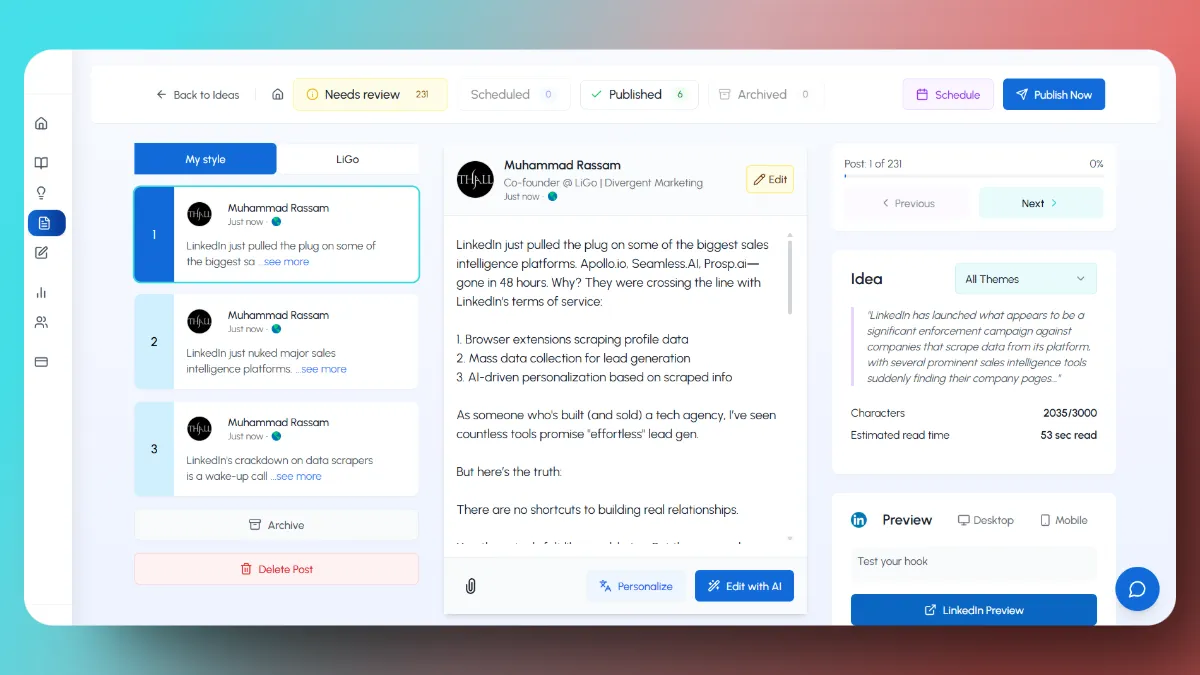
Der LinkedIn-Algorithmus bevorzugt Posts, die Nutzer länger auf der Plattform halten. Um die Verweildauer zu erhöhen:
-
Verwenden Sie Zeilenumbrüche zwischen Absätzen
-
Beginnen Sie mit einem starken Hook in den ersten 1–2 Zeilen
-
Heben Sie zentrale Punkte oder Erkenntnisse fett hervor
-
Setzen Sie Emojis strategisch als visuelle Marker ein
-
Vermeiden Sie große Textblöcke, die vom Lesen abschrecken
Engagement-Strategien
Um die Performance Ihrer Posts zu maximieren:
-
Antworten Sie auf jeden Kommentar, idealerweise innerhalb von 24 Stunden
-
Stellen Sie Kommentierenden Rückfragen, um Gespräche zu verlängern
-
Markieren Sie relevante Kontakte, wenn es passt (ohne zu spammen)
-
Interagieren Sie kontinuierlich mit den Inhalten anderer – nicht nur, wenn Sie selbst posten
Wie LiGo Ihnen bei der Umsetzung dieser Ideen hilft
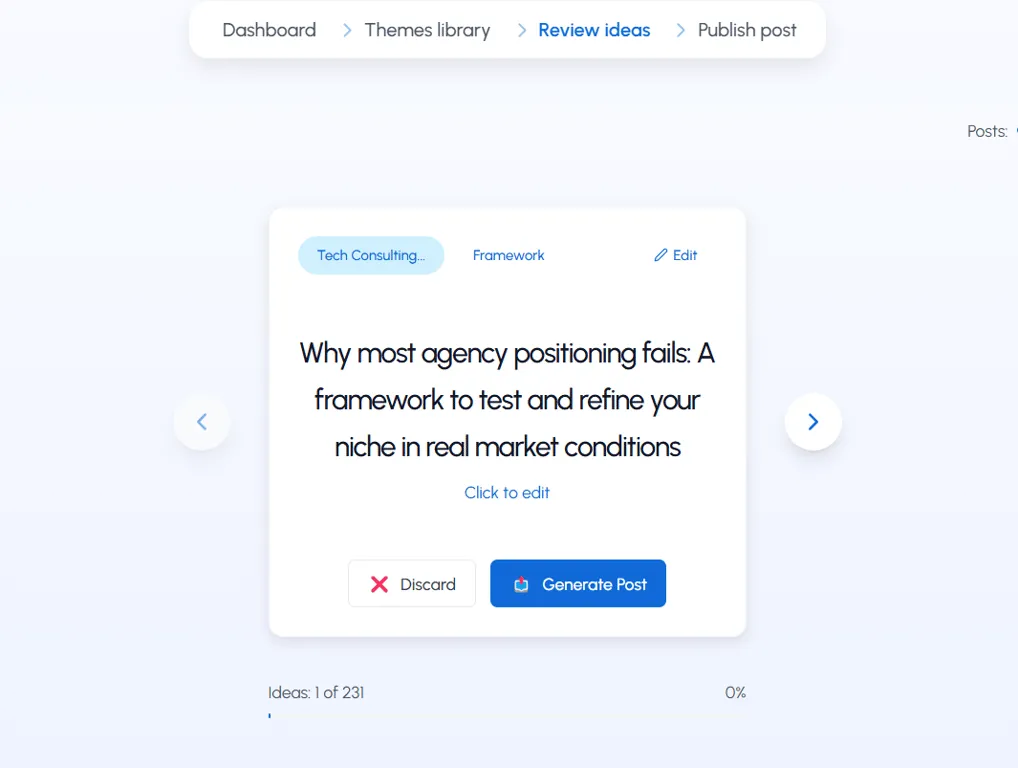
Eine konsistente LinkedIn-Präsenz zu pflegen, während man eine Agentur oder ein Unternehmen führt, kann herausfordernd sein. LiGo hilft Ihnen dabei:
-
Content-Ideen generieren: Erstellen Sie thematische Content-Buckets passend zu Ihrer Expertise mit unserer Content-Theme-Funktion
-
Ansprechende Posts entwickeln: Generieren Sie schnell mehrere Varianten von Posts auf Basis Ihrer Ideen
-
Konsistenz wahren: Planen und verwalten Sie Ihren LinkedIn-Content-Kalender
-
Performance verfolgen: Verstehen Sie mit unseren detaillierten Analytics, welche Posts das meiste Engagement erzeugen
-
Zeit sparen: Konzentrieren Sie sich auf die Strategie, während LiGo Content-Erstellung und Planung übernimmt
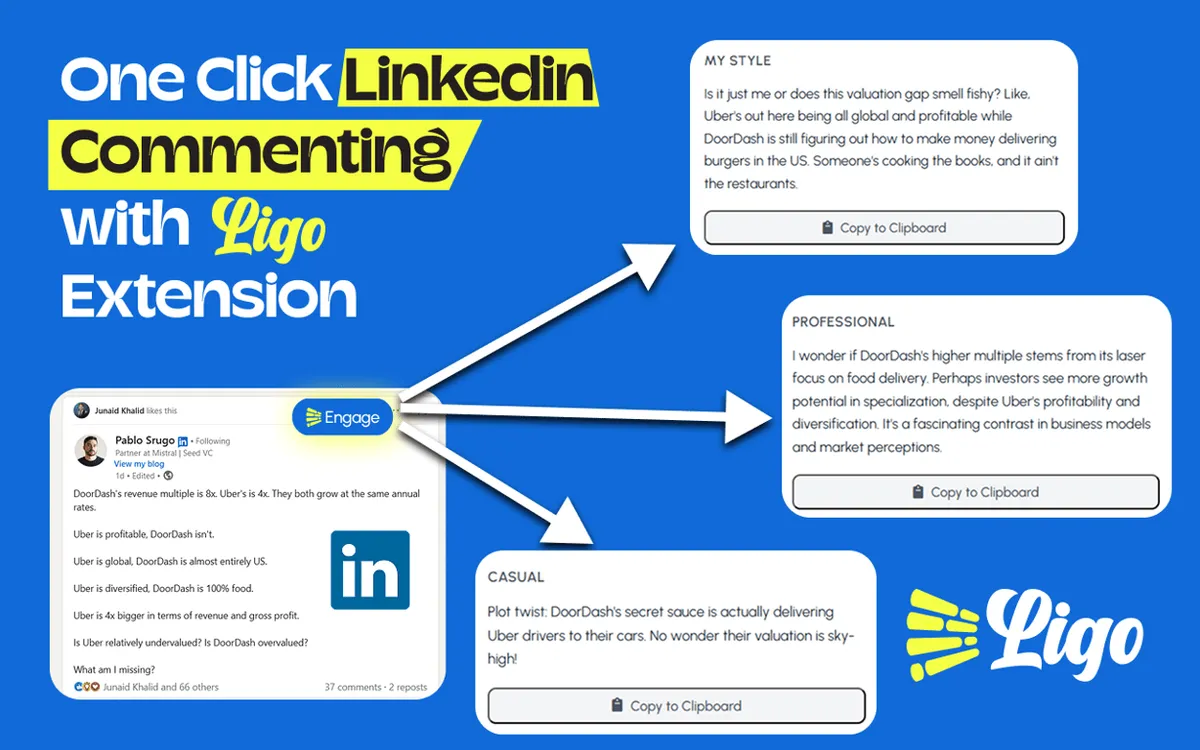
Mit der Chrome-Erweiterung von LiGo können Sie sogar beim Surfen LinkedIn-Posts generieren – so einfach war es noch nie, eine konsistente Präsenz zu pflegen.
Fazit
LinkedIn bleibt eine der wirkungsvollsten Plattformen für Agenturinhaber und Gründer, um Autorität aufzubauen, Kunden zu gewinnen und Thought Leadership zu etablieren. Der Schlüssel zum Erfolg liegt nicht darin, mehr zu posten, sondern strategisch zu posten – mit Inhalten, die bei Ihrem Publikum ankommen und zu bedeutungsvollem Engagement anregen.
Mit diesen 25 wirkungsstarken Post-Ideen und Best Practices können Sie eine LinkedIn-Content-Strategie entwickeln, die konstant Engagement erzeugt, ohne Stunden Ihrer wertvollen Zeit zu verschlingen. Denken Sie daran: Die erfolgreichsten LinkedIn-Inhalte sind authentisch, bieten Mehrwert und laden zum Gespräch ein.
Wählen Sie zunächst einige Ideen aus, die zu Ihrer Expertise und den Bedürfnissen Ihres Publikums passen, und erweitern Sie dann Ihr Repertoire, während Sie einen nachhaltigen Posting-Rhythmus entwickeln. Mit diesen Strategien und den richtigen Tools wie LiGo können Sie eine LinkedIn-Präsenz aufbauen, die 2025 und darüber hinaus echte Geschäftsergebnisse liefert.
Bereit, Ihre LinkedIn-Strategie zu transformieren? Testen Sie LiGo noch heute und erleben Sie, wie unsere KI-gestützten Content-Tools Ihnen helfen, bessere LinkedIn-Inhalte schneller zu erstellen.
Sie möchten mehr über die Optimierung Ihrer LinkedIn-Präsenz erfahren? Lesen Sie diese verwandten Artikel: