
Key findings
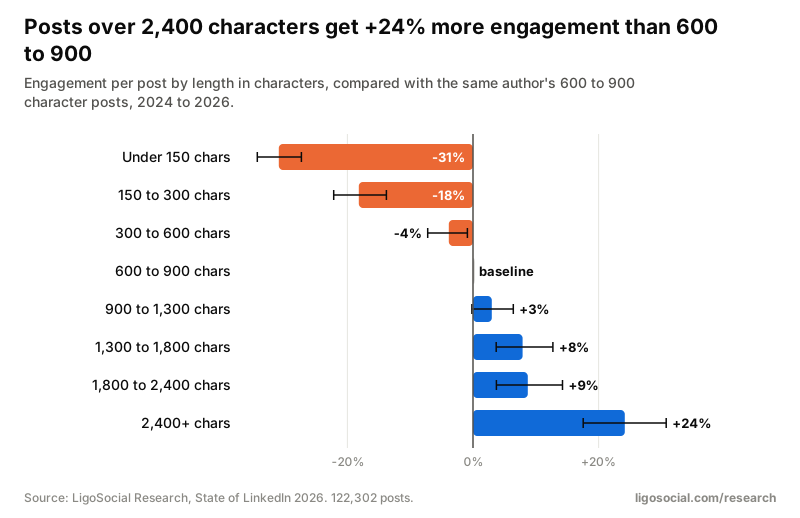
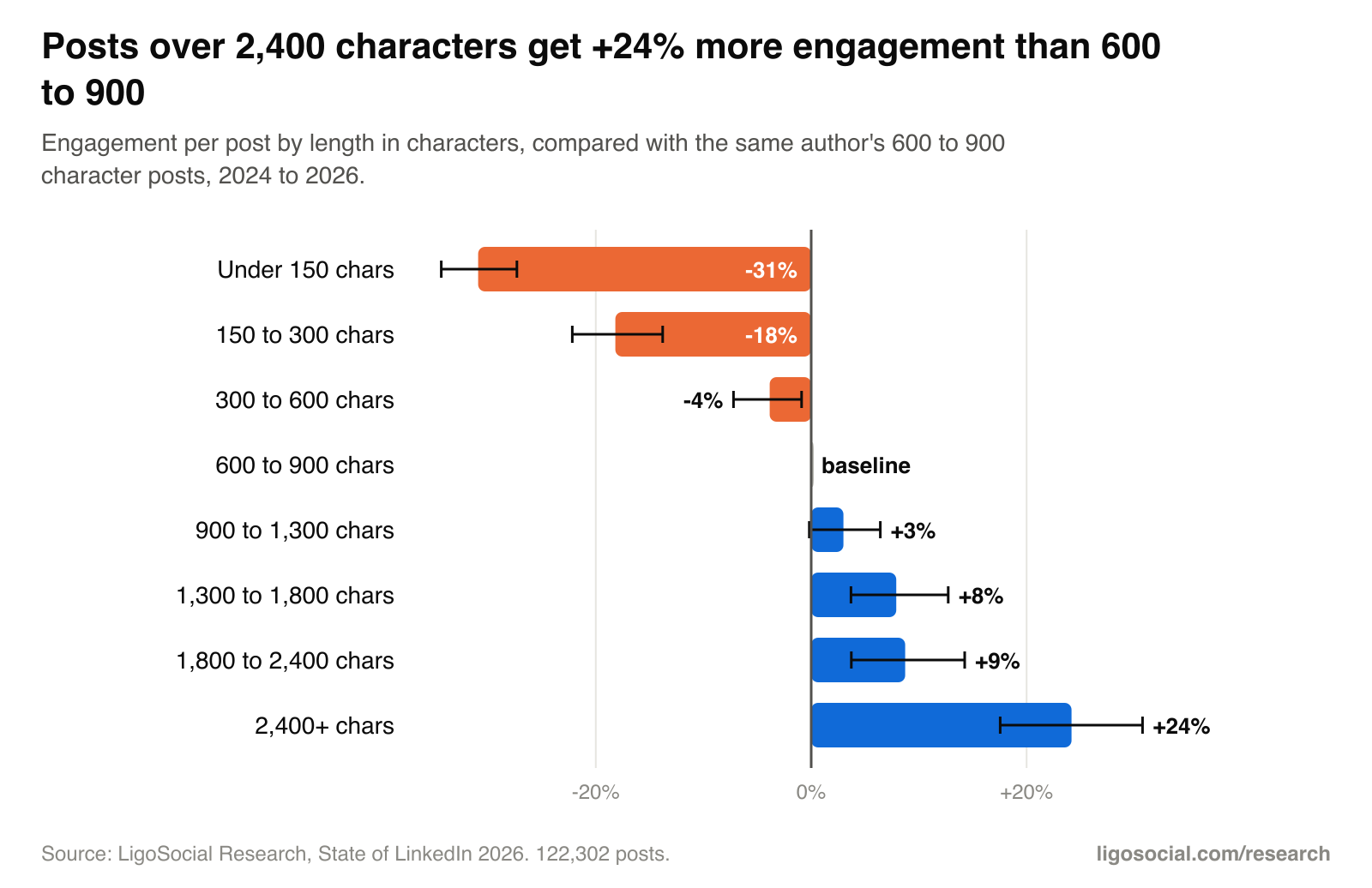
- 2,400+ characters +24%, 1,300 to 1,800 +8%, under 150 -31% vs 600 to 900, same author.
- The premium holds in every follower band and for comments.
- Choppy one-line formatting and first-line length barely matter.
Contents
The short answer
Longer posts get more engagement, all the way up to LinkedIn's 3,000 character limit. Compared with the same author's 600 to 900 character posts, posts over 2,400 characters got +24%, and posts under 150 characters -31%. There is no sweet spot in the middle where the curve turns down.
By follower band
| Followers | Under 150 | 300 to 600 | 600 to 900 | 900 to 1300 | 1300 to 1800 | 1800 to 2400 | 2400+ |
|---|---|---|---|---|---|---|---|
| All authors | -31% | -4% | baseline | +3% | +8% | +9% | +24% |
| Under 1,000 | -26% | -6% | baseline | +4% | +15% | +11% | +18% |
| 1,000 to 3,000 | -34% | -4% | baseline | 0% | 0% | -2% | +18% |
| 3,000 to 6,000 | -33% | 0% | baseline | +4% | +17% | +23% | +28% |
| 6,000 to 10,000 | -31% | -2% | baseline | +2% | +11% | +16% | +42% |
| 10,000+ | -28% | -8% | baseline | +8% | +3% | +6% | +18% |
Characters. n/a: cell below our minimum size. 2024 to 2026.
The long-post premium is largest at 6,000 to 10,000 followers (+42% for 2,400+) and 3,000 to 6,000 (+28%). Short posts under 300 characters lose in every band.
Line breaks and first lines matter less than you think
We also measured formatting. Posts with short, choppy lines (under 40 characters on average) did no better than posts with normal paragraphs (-1% vs 70 to 110 characters per line). The length of the first line barely mattered (+7% for under 40 characters vs 40 to 70). What you say matters more than how you break the lines.
+33%
Finding 15
Open with a moment, not a question
Posts whose first line opens a story got +33% engagement vs the same author's bold-claim openers (95% CI +24% to +41%). Question openers got -8%. Questions are the second most common opening (17% of posts); story openings are only 13%.
Why longer might win
Post what the data says works, in your own voice
LigoSocial learns how you write from your own LinkedIn posts, then drafts posts, comments and replies in that voice right inside LinkedIn. You approve what goes out.
Add LigoSocial to ChromeOr try it at ligosocial.comCommon questions
- How long should a LinkedIn post be?
- In our data, longer did better: 1,300+ characters beat 600 to 900 characters, and 2,400+ characters did best (+24%). Under 300 characters was clearly worse.
- What is the ideal LinkedIn post length in 2026?
- Between 1,300 and 3,000 characters, if the content earns it. Posts under 150 characters got -31% vs 600 to 900.
- Does the "see more" cut-off hurt long posts?
- Not in our data. Long posts beat short ones even though readers must click to expand them. Make the first two lines worth the click.
Download the data
- CSV
Post length effects by follower band
Engagement vs the same author's 600 to 900 character posts.
48 rows, CSV
Suggested citation
LigoSocial Research (2026). How long should a LinkedIn post be? What 134k posts show. https://ligosocial.com/research/linkedin-post-length
Free to reuse under CC BY 4.0: quote the numbers, embed the charts or rework the data, with credit to LigoSocial Research and a link to this page. Every figure is aggregated and anonymised; no individual, profile or post can be identified.
Does your next post read as AI?
Paste it into the free LinkedIn AI Detector. It scores the post and points at the phrases and patterns that give it away. Nothing you paste is stored.
How we collect, clean and anonymise the data: methodology. Questions or a cut we have not published? Ask us.
Related research
- Annual reportThe State of LinkedIn 2026: what works for everyday professionals40 findings from 134,522 posts, plus what works at each follower count.
- ReportDo AI-written LinkedIn posts get less engagement?AI-sounding posts get 22% less engagement, and the share of them peaked in 2024 to 2025.
- ReportEm dashes and AI: how often LinkedIn posts use themEm dash use rose sevenfold, then fell. The dash is a marker, not the problem.
- ReportLinkedIn post formats compared: images, carousels, video, text, links and pollsImages +36%, link previews -15%, polls -50%. Carousels only pay past 10 pages.
- ReportDo hashtags work on LinkedIn? What 134k posts showHashtags: no penalty, small lift. Tagging people: +35% to +126%.
Comments follow length too
Comments rise with length in the same way: +19% for 2,400+ characters vs 600 to 900, and -23% under 150. Longer posts give people something to respond to.