
LigoSocial Research/Report
Vulnerability on LinkedIn: what 16,511 posts show
Are more people on LinkedIn sharing their failures, setbacks and hard moments, and do those posts actually do better? We measured it across four years of real posts, then checked our AI labels against a blind second review.
Sample16,511 posts from 1,568 real LinkedIn profiles, January 2023 to November 2026
- Posts sharing a personal struggle, 2023 to 2026
- 4.9% to 7.4%
- Posts sharing a personal struggle, 2023 to 2026
- Engagement on struggle posts
- +49%
- Engagement on struggle posts
- same author
- Posts sharing a clear personal hardship, 2025 and 2026
- about 1%
- Posts sharing a clear personal hardship, 2025 and 2026
- Under-30s vs older authors, struggle posts
- No gap
- Under-30s vs older authors, struggle posts
Key findings
- Posts where the author shares a struggle, failure or mistake of their own: about 4.9% in 2023 and 2024, about 7.4% in 2025 and 2026.
- The same 516 people shared more in 2026 than in 2024 (5.3% to 7.6%), so it is not just new users.
- Those posts got +49% engagement and +47% comments vs the same author's other posts.
- Clear personal hardship (a layoff, burnout, grief, a business failing) is rare: about 1 post in 100.
- Under-30s do not share struggles more often, but they post more first-person stories (11.6% vs 8.5%).
Contents
The short answer
Yes, people share more of their struggles on LinkedIn than they did, and it pays. Posts in which the author talks about a failure, setback, mistake or hard moment of their own went from about 4.9% of posts in 2023 and 2024 to about 7.4% in 2025 and 2026, and they got +49% engagement compared with the same person's other posts. But most of this openness is mild: a lesson from a mistake, a nervous moment, a hard year on the way to a win. Posts about a clear personal hardship, such as being laid off, burning out or a business failing, are still only about 1 post in 100.
Are more people sharing struggles?
4.9% to 7.4%
Finding 1
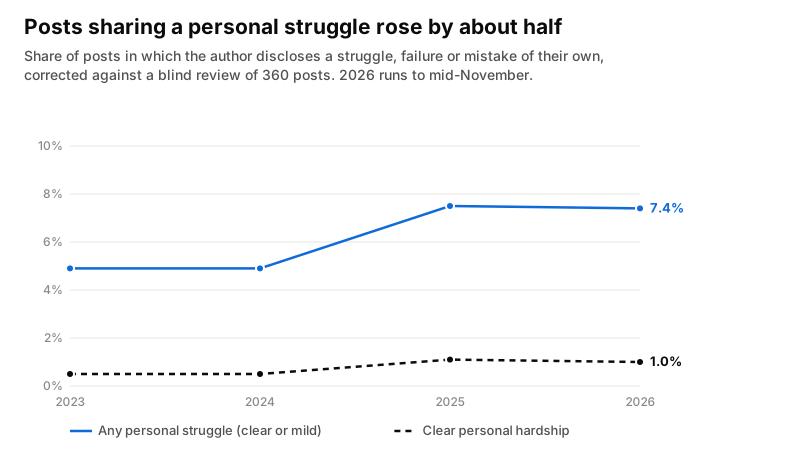
Struggle posts rose by about half, in one step from 2024 to 2025
Posts where the author shares a struggle, failure or mistake of their own (clear or mild): 4.9% in 2023, 4.9% in 2024, 7.5% in 2025 and 7.4% in 2026. Among the same 516 people who posted in both 2024 and 2026, the share went from 5.3% to 7.6% (+2.3 points, 95% CI +1.3 to +3.5). The rise happened between 2024 and 2025 and then levelled off.
about 1 in 100
Finding 2
Clear personal hardship is still rare, but it doubled
Posts that openly describe a real hardship, such as being laid off, burnout, grief, illness, money trouble or a business failing, made up about 0.5% of posts in 2023 and 2024 and about 1.0% to 1.1% in 2025 and 2026. For the same 516 people, 2024 to 2026: 0.6% to 1.0% (+0.4 points, 95% CI +0.1 to +0.75). The rate roughly doubled, but from a very low base.
| Year | Authors | Posts | Any struggle (clear or mild) | Clear personal hardship |
|---|---|---|---|---|
| 2023 | 423 | 2,214 | 4.9% | 0.5% |
| 2024 | 717 | 3,727 | 4.9% | 0.5% |
| 2025 | 1,085 | 5,546 | 7.5% | 1.1% |
| 2026 | 972 | 5,024 | 7.4% | 1.0% |
Author-weighted: each author's share first, then the average across authors with 3+ posts that year. Corrected against a blind second review of 360 posts (see How we measured it). 2026 runs to mid-November.
Does being open get more engagement?
+49%
Finding 3
Posts that share a struggle get about half as much engagement again
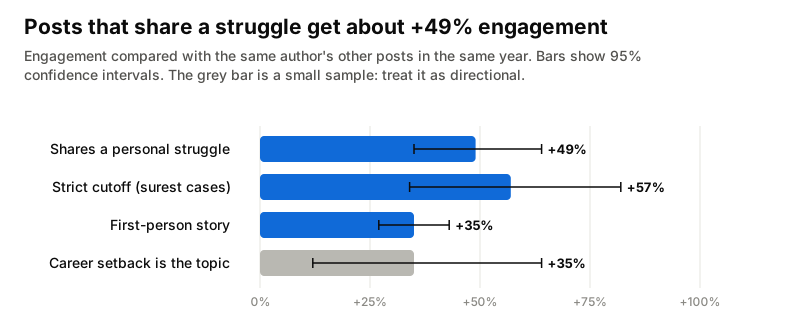
Posts in which the author shares a struggle of their own got +49% engagement (95% CI +35% to +64%) and +47% comments vs the same author's other posts in the same year. On the surest cases only (a strict cutoff) the lift was +57% (CI +34% to +82%). It held in every year from 2023 to 2026, and outside story posts too (+47%), so it is not only the story effect.
+35%
Finding 4
Career setback posts also do better, on a small sample
Posts whose main subject is the author's own career or business setback (a layoff, a rejection, burnout, a costly mistake, a business that failed) got +35% engagement vs the same author's other posts (95% CI +12% to +64%). Only 83 such posts from 76 authors were in our sample, below our 200-post rule, so treat this as directional.
Are younger people more open?
11.6% vs 8.5%
Finding 5
Under-30s do not share struggles more often, but they tell more stories
We do not know anyone's real age, so we estimated it from the start year of their first listed education. Authors who look under 30 shared struggles at about the same rate as older authors (3.7% vs 3.4% of posts on the AI judge's flag; difference +0.3 points, 95% CI -0.6 to +1.2). Where they do differ is storytelling: 11.6% of their posts were first-person stories, against 8.5% for authors 30 and over (+3.1 points, CI +1.1 to +5.2).
The engagement lift for struggle posts was not bigger for younger authors. Their sample is too small to give a separate figure.
How we measured it
The sample. We selected 16,511 public posts from 1,568 personal LinkedIn profiles. Selection criteria: the profile owner connected it to LigoSocial, posts of 150+ characters, January 2023 to mid-November 2026. To stop heavy posters from dominating, we took at most 5 random posts per author per year. Users who turned off "Save my post analytics" are left out. Full details are in our methodology.
Labelling. An AI judge (Jev, from TypeSafe) read the first 1,200 characters of each post and answered three yes or no questions: does the author disclose a personal struggle, failure, mistake or hardship of their own; is the core of the post a career or business setback; and is it a first-person story about a specific moment.
Checking the labels. We then drew a stratified random sample of 360 posts from all four years, across the full range of the judge's scores, and had them reviewed blind (without the judge's scores) by a separate, larger AI model following a written rubric: clear personal hardship, a mild disclosure such as a lesson from a mistake, or none. Of the posts the judge flagged, 86% shared a struggle (clear or mild) and 20% a clear hardship. The judge caught about half of all struggle posts and about 92% of clear hardship posts. We used these rates to correct the shares above, stratum by stratum. Its setback flag was right 85% of the time.
| Measure | 2023 | 2024 | 2025 | 2026 |
|---|---|---|---|---|
| Flagged by the AI judge (raw) | 2.4% | 2.5% | 4.5% | 4.6% |
| Any struggle, corrected | 4.9% | 4.9% | 7.5% | 7.4% |
| Clear hardship, corrected | 0.5% | 0.5% | 1.1% | 1.0% |
The judge misses many mild disclosures, so the corrected share of any struggle is higher than the raw flag, and the clear-hardship share is lower.
Engagement is reactions + comments + reposts. Each post is compared with the same author's other posts in the same year, which removes differences in follower count and popularity. Engagement results use the judge's flags (86% of them true struggle posts), so the lift describes posts that share a struggle, mostly mild ones. 95% confidence intervals come from resampling authors.
Privacy. Aggregates only. No names, profiles or post text are published or quoted, and every number covers at least 30 authors and 200 posts unless marked directional. LigoSocial Research is independent and is not affiliated with, endorsed by or sponsored by LinkedIn Corporation.
- Our authors chose a LinkedIn growth tool, so they are more active and more senior than the average LinkedIn member. These are not figures for LinkedIn as a whole.
- Age is a proxy from education dates, not a date of birth. Treat the under-30 group as rough.
- Both the judge and the review are AI models. A human hand-labelling pass would tighten the corrected shares, especially for mild disclosures.
- Observational data: associations, not proof of cause. A LinkedIn algorithm change or the spread of AI writing tools could also shift how people write.
- Engagement is not the same as a good outcome such as leads, hiring or reputation. We have no data on those.
Common questions
- Are people more vulnerable on LinkedIn than they used to be?
- Yes, a little. In our data, posts where the author shares a struggle, failure or mistake of their own went from about 4.9% of posts in 2023 and 2024 to about 7.4% in 2025 and 2026. The same people shared more, so it is not only new users.
- Do vulnerable posts get more engagement on LinkedIn?
- Yes. Posts sharing a personal struggle got +49% engagement and +47% comments compared with the same author's other posts (95% CI +35% to +64%).
- Do posts about failure or rejection perform better?
- Probably. Posts whose main subject is a career setback got +35% engagement vs the same author's other posts, but only 83 such posts were in our sample, so this is directional.
- Are younger people more vulnerable on LinkedIn?
- Not in our data. Authors who look under 30 shared struggles at about the same rate as older authors. They did post more first-person stories: 11.6% of posts vs 8.5%.
Download the data
- CSV
Vulnerability on LinkedIn: all published numbers
Shares by year (raw and corrected), same-author changes, engagement effects and age-proxy comparisons.
24 rows, CSV
Suggested citation
LigoSocial Research (2026). Vulnerability on LinkedIn: are people sharing more struggles, and does it pay? https://ligosocial.com/research/vulnerability-on-linkedin
Free to reuse under CC BY 4.0: quote the numbers, embed the charts or rework the data, with credit to LigoSocial Research and a link to this page. Every figure is aggregated and anonymised; no individual, profile or post can be identified.
Does your next post read as AI?
Paste it into the free LinkedIn AI Detector. It scores the post and points at the phrases and patterns that give it away. Nothing you paste is stored.
How we collect, clean and anonymise the data: methodology. Questions or a cut we have not published? Ask us.
Related research
- Annual reportThe State of LinkedIn 2026: what works for everyday professionals40 findings from 134,522 posts, plus what works at each follower count.
- ReportDo AI-written LinkedIn posts get less engagement?AI-sounding posts get 21% less engagement, and the share of them peaked in 2024 to 2025.
- ReportWhat is a good LinkedIn engagement rate? Benchmarks by follower countTypical engagement rate 0.32%; 0.96% under 1,000 followers, 0.12% at 10,000+.
- MethodHow we built the State of LinkedIn 2026 datasetData, privacy rules, the within-author metric and label calibration.